The sugar cube carried Albert Sabin’s oral polio vaccine, a live, weakened virus you swallowed instead of getting a shot. It was licensed in stages from 1961 to 1963, handed out at mass “Sabin Oral Sunday” clinics, and used in the U.S. until Jan. 1, 2000, when the country switched to the shot alone.
On six Sundays in the summer of 1962, Cleveland volunteers handed out 5,000,000 sugar cubes, each one in its own tiny paper cup. That’s about three cubes for each of the more than 1.5 million Clevelanders who took the vaccine, because it came as three separate types of vaccine, Type I, Type II and Type III, given weeks apart, and you came back for each one.
The cube in that cup had three drops of the vaccine on it, a weakened virus that was still alive, and you swallowed it with the sugar. Jonas Salk’s vaccine from 1955 did the same job but it used a killed virus and came in a shot.
What a Sabin Oral Sunday looked like
On the nights before Phoenix’s first two Sabin Oral Sundays, SOS for short, an airplane flew over the city from dusk until 10 p.m. with a flashing neon sign. On the first of them, in January 1962, as PHOENIX magazine told it in 2026, 250,000 people got the vaccine. Four National Guard helicopters moved supplies around, guided by ham radio operators, and the vaccine still ran out. The 59 clinics had to send about 100,000 people home without it.
The doses came in order. Pfizer, which made Maricopa County’s vaccine, recommended Type II four to six weeks after Type I, and Type III eight to 12 weeks later. So a Phoenix family that started in January wasn’t done until spring.
Over in Ohio, Cleveland’s medical academy decided on its own drive when Sabin came to town on April 3, 1962, and the academy had seven weeks to get ready. Signing for a program estimated at $500,000 took nerve, mind you, for an academy with $900 in its treasury, as its own history tells it.
The clinics ran from noon to 6 p.m. Pharmacists put three drops on each of tens of thousands of cubes, “the important and fatiguing task,” in the academy’s words, while policemen from each town directed traffic. And the SOS phone line, CE 1-8000, known as the “polio” number, got so many calls that seven phone sets went in, with nine lines on each.
This is the damndest, most fantastic traffic jam I’ve ever seen in 26 years on the force—but nobody is sore about it. And neither am I.
As far as I could find nobody wrote down why the clinics were held on Sundays, so this part is my own reading of the record. Sunday was the day a school building stood empty, and every clinic in the Arizona drive was scheduled for a Sunday, and school buildings were the clinic sites. Cleveland’s opened at noon, and the first two and a half hours brought about 40% of the people each clinic served, which fits families coming on from church. Rusty Foley’s family went to Arcadia High School, in Phoenix, after church.
Whatever the reason for the day, it worked in Phoenix, judging by what the Maricopa County Medical Society’s director told The Arizona Republic. The only yardstick they had was the Salk program of a year and a half before, and “the SOS program had five times that response within four hours.”
Phoenix gave the vaccine free and asked for a voluntary donation of 25 cents. Bismarck and Los Angeles asked a quarter a dose, and Los Angeles promised that nobody would be refused. A quarter in 1962 is about $2.78 in today’s money, or about 13 minutes of work at the $1.15 federal minimum wage.
Jim Tucker, who grew up to be a pediatrician in Pittsburgh, was 10 when his turn came, at a Saturday clinic in Elkins Park, Pa. Card tables, with colorful balloons tied on with string. Several mothers brought the cookie sheets they used for chocolate-chip cookies the rest of the year. “Hundreds of sugar cubes were lined up on them in tidy little rows,” he wrote in the Pittsburgh Post-Gazette in 2021. “Several drops of the pink polio vaccine were dripped onto each one.”
A Fort Worth Star-Telegram caption from July 1962 gave readers the whole drill. Everyone would get three drops of vaccine on a sugar cube, and “all you do is chew it up.” That August a 6-year-old, Jim Krum, was at the Central Fire Station and watched a pharmacist, J.R. Kilman, put the vaccine on the cubes.
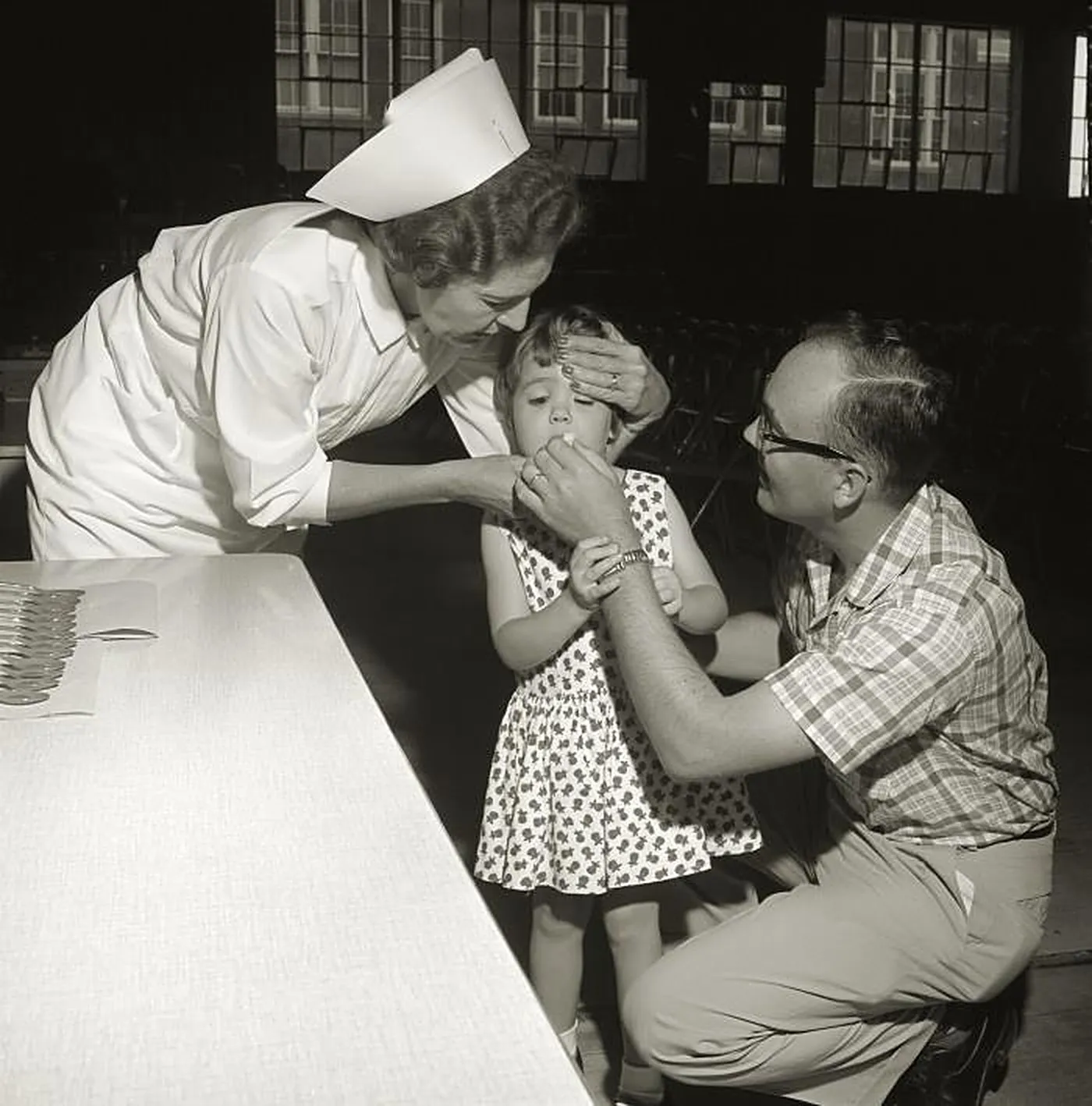
A father gives his daughter her sugar cube at a high school clinic in Decatur, Ga., 1961. Photo by George Stenhouse, CDC Public Health Image Library, public domain.
Why a sugar cube instead of a shot
The vaccine itself tasted bitter and salty, Cincinnati Children’s notes. That’s why it could be given on a sugar lump, or in a spoonful of a sweet syrup known as Sabin Syrup.
The Los Angeles County health officer went through the new vaccine’s advantages in the Torrance Herald in August 1962. “Perhaps the chief one as far as most people are concerned,” the officer wrote, was that it was “given by mouth (usually on a lump of sugar) instead of by injection.” A 2022 profile of Sabin in the CDC’s journal, Emerging Infectious Diseases, adds that the oral vaccine was easier to give and cost less than the shot.
Charmaine Brock Schlick got hers at Ritter Elementary School in Tempe, Ariz. “Everyone was excited about getting the sugar cubes in a small white disposable cup,” she told PHOENIX magazine. “It was such a relief for me because those old vaccine guns had terrified me, and I was a pretty tough little kid.”
The boy in the 1962 Atlanta photo at the top of this page wasn’t so sure. In the CDC’s own caption, he is “eyeing the sugar cube apprehensively.”
Salk’s shot had been licensed on April 12, 1955, three years after the worst polio year, 1952, when the country had more than 21,000 paralytic cases. Having had it didn’t keep you out of the Sunday line. “My brother and I had already had the Salk vaccine, but my parents believed adding Sabin’s was important,” Rusty Foley said.
How many came, town by town
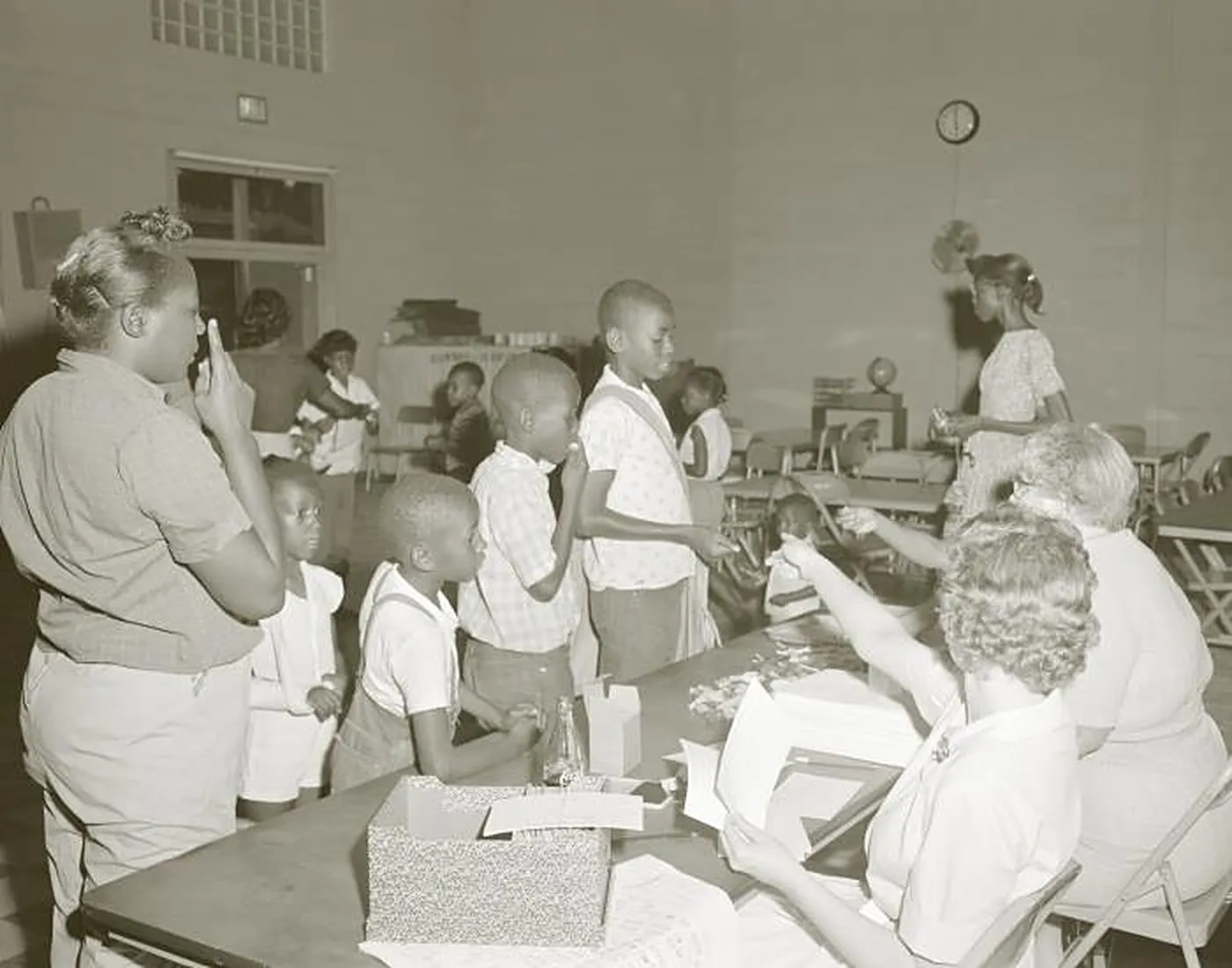
Boys at the paperwork table of a mass vaccine clinic, Georgia, 1961. CDC Public Health Image Library, public domain.
| Where | When | How it was given | How many came |
|---|---|---|---|
| Cincinnati and Hamilton County, Ohio | April 24, 1960 | Sugar cubes | 186,000, by Cincinnati Children’s count |
| Maricopa and Pima counties, Ariz. | Sundays, starting Jan. 1962 | Sugar cubes, in school buildings | 754,000 over the whole program, about 75% of both counties |
| Omaha (Douglas and Sarpy counties), Neb. | May 27, 1962 | Cherry-flavored syrup | More than 314,000, or 84.9% of the population |
| Cleveland | Six Sundays, summer 1962 | Sugar cubes in paper cups | More than 1.5 million |
| Fort Worth | July 1962 | Sugar cube with three drops | 67 sites; no count found |
| Burleigh and Morton counties (Bismarck and Mandan), N.D. | Sept. 1962 | 13 clinics, plus mobile units for shut-ins | Nearly 30,000 in six hours |
| Los Angeles and five other Southern California counties | Oct. and Dec. 1962, with more Sundays planned for Jan. 1963 | A cube of sugar or a sip of syrup | About 600 clinics planned in Los Angeles County; goal of 9,000,000 people |
| Palm Beach County, Fla. | One Sunday, Jan. 1964 | Sugar cubes or cherry-flavored water, some at drive-ins | 161,400 |
Cincinnati, where Sabin had worked since 1939, went first, before any oral vaccine had been licensed. People lined up outside Cincinnati Children’s Hospital and at schools and churches.
Arizona’s count comes from the doctors who ran the drive, writing in JAMA in January 1963. The CDC kept its own count, state by state, of the mass programs it knew about. It came out in Poliomyelitis Surveillance Report No. 278 in July 1963. From licensing through June 1963, those programs gave about 43 million doses of Type I, 30 million of Type II and 26 million of Type III. September 1962 was the busiest month for Type I, with 9.86 million doses.
The states differ on how many came back for the later doses. California held nearly level from Type I to Type III, while Texas gave less than a third as many Type III doses as Type I. The report doesn’t say why. It counts mass programs only, so some of those children may have finished the series at a doctor’s office instead, and the table can’t tell us how many.
| State | Type I | Type II | Type III |
|---|---|---|---|
| California | 10.1 million | 9.7 million | 9.9 million |
| Arizona | 958,000 | 867,000 | 890,000 |
| Ohio | 5.8 million | 4.4 million | 4.3 million |
| Texas | 6.6 million | 3.7 million | 2.1 million |
Doses given in mass programs from licensing through June 1963, rounded. CDC, Poliomyelitis Surveillance Report No. 278, Table II.
Not everyone got a cube
Omaha drank its vaccine in cherry-flavored syrup, and History Nebraska titled its account “What happened when a million Nebraskans drank Polio Punch.” Local TV ran it like a telethon, with tote boards tallying the numbers as they were phoned in. KMTV’s own look back says the station “covered it like an election,” live during a baseball game, and Sabin joined the broadcast from Ohio.
In Palm Beach County, Fla., in 1964, some of the clinics were drive-in theaters. The Boynton Beach Historical Society collected memories of the one in Delray Beach. Robin Raborn was one of the people the families got their cups from. “I remember running back and forth, delivering tiny paper cups with the sugar cubes to the families driving through,” she said. Some cups didn’t have a cube at all, just three drops in a little water, cherry-flavored for some.
Thomas Bruce Smith remembers that “they sent the cars into three lanes, you pulled up and they gave you little paper cups.” The account goes on: “The lanes were segregated with two lanes for white families and one lane for black and brown residents.”
Type III and the 11 cases of 1962
Was it safe? That same August piece in the Torrance Herald put the number of people around the world who had probably taken Sabin’s vaccine at more than 100 million. “As far as is known,” the officer wrote, “not a single case of poliomyelitis has been caused by its administration.”
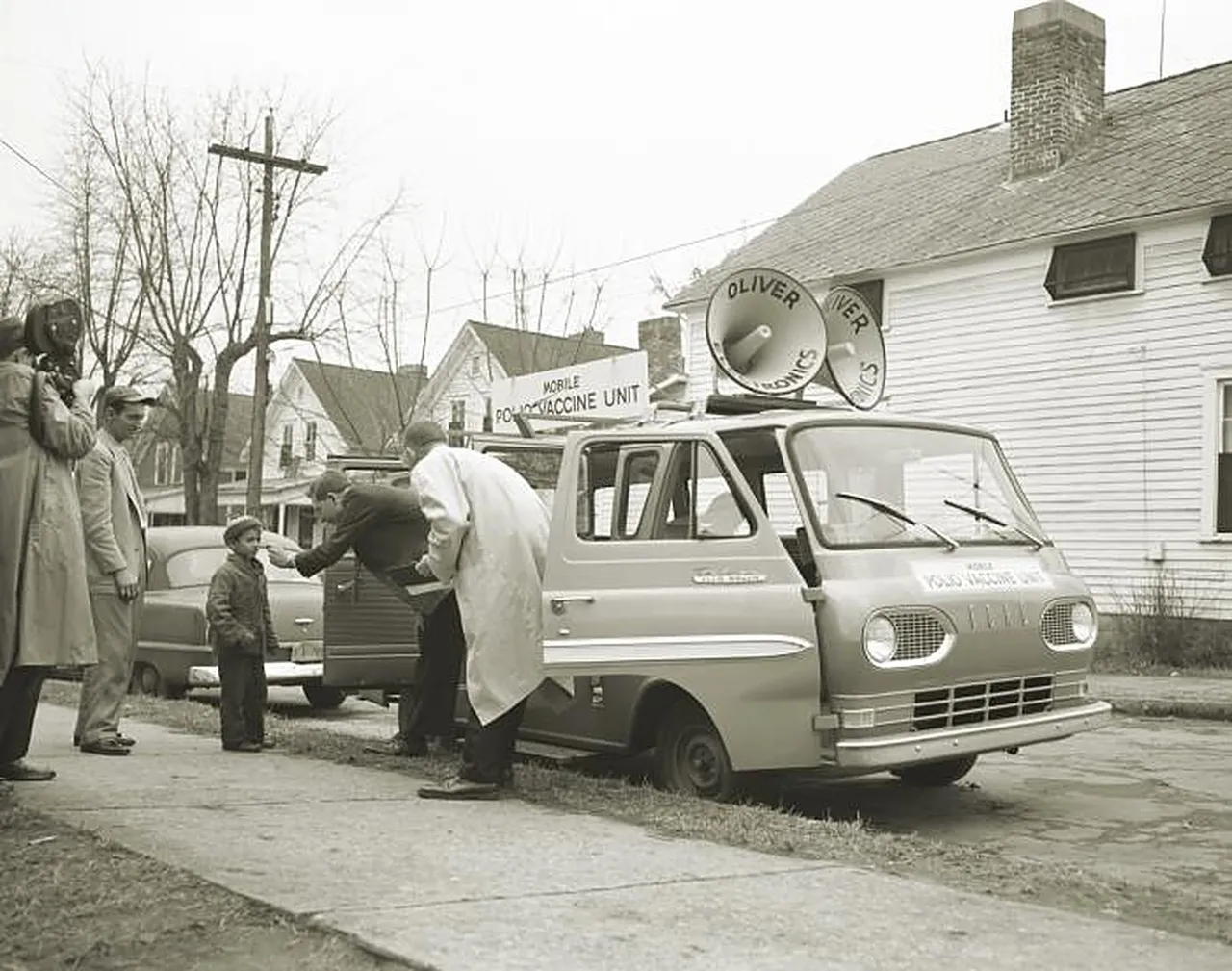
In Nebraska that year, nine people “developed an illness compatible with” polio within weeks of taking the Type III vaccine. In September the Public Health Service pulled back on Type III while it investigated. The CDC’s report of Oct. 5 says Type III was to go on for preschool and school-age children “but not for adults at this time.” Los Angeles had planned Type III for two Sundays in December, and by late November those Dec. 2 and 9 clinics were set to give Type II instead.
On Dec. 20 the Omaha World-Herald reported 11 confirmed polio cases nationwide after Type III, eight of them in people over 30. The Public Health Service had found those 11 among 15 million doses, History Nebraska writes. It lifted its hold with the advice that the vaccine be “used for adults only with the full recognition of its very small risks.” So the answer in 1962 was yes for children, and for adults a very small risk that doctors were told to weigh.
Why the U.S. stopped using the oral vaccine
The last wild polio caught in the United States was in 1979. From 1980 through 1999 the country had 162 confirmed cases of paralytic polio. The weakened Sabin strains in the oral polio vaccine, or OPV, caused 154 of them, about one case for every 2 to 3 million doses.
In the late 1990s the country first moved to shots followed by drops. On June 17, 1999, the Advisory Committee on Immunization Practices voted for shots only, starting Jan. 1, 2000. The last vaccine-associated case caught on U.S. soil was reported in 1999. Since 2000 only the shot has been given here, “to eliminate the risk of polio variants that can occur with OPV,” in the CDC’s words.
The cube and Mary Poppins
Robert Sherman co-wrote the songs for the 1964 film Mary Poppins. As Cincinnati Children’s tells it, he said the words to “A Spoonful of Sugar” came to him not long after Jeffrey, his 5-year-old, told him how he’d taken the Sabin vaccine with some sugar at school one day.
Questions people ask
What vaccine was given on a sugar cube in the 1950s?
In the United States the polio vaccine of the 1950s was Jonas Salk’s shot, licensed in 1955. Sabin’s oral vaccine, the one that went on the sugar cube, had its first large-scale U.S. use in Cincinnati on April 24, 1960, and was licensed in stages from 1961 to 1963.
When did they stop giving the polio vaccine on sugar cubes?
The oral vaccine was used in the U.S. until Jan. 1, 2000, when the country switched to the shot alone. When clinics stopped putting the drops on a sugar cube is harder to pin down. I didn’t find a record that dates the last cube, and even in 1962 the drops went on cubes in some towns and into a syrup in others.
Is the sugar cube polio vaccine still effective?
According to the CDC, “most adults in the United States were vaccinated as children and are therefore likely to be protected from getting polio.”
What was the polio vaccine scandal?
That’s most likely the Cutter incident of 1955. That year some lots of the vaccine that reached the public still carried live poliovirus, though they had cleared the required safety tests, and the CDC ties more than 250 polio cases to vaccine from a single maker, Cutter Laboratories. After the government improved the process and increased oversight, vaccinations resumed that fall.
Did Sabin patent his vaccine?
No. Like Salk, Sabin didn’t patent his vaccine, because he wanted it used as broadly as possible.
Written by Wance Payton, Oct. 23, 2026
24 sourcesWhere these facts come from
- Cincinnati Children's Hospital Medical Center, "Vaccine History"
- Cincinnati Children's Hospital Medical Center, "Timeline Detail: 1960-69"
- CDC, "Epidemiology and Prevention of Vaccine-Preventable Diseases" (Pink Book), Chapter 18: Poliomyelitis, 2024
- CDC, "Poliomyelitis Prevention in the United States: Updated Recommendations of the ACIP," MMWR, May 19, 2000
- CDC, "Polio Vaccination"
- CDC, "Historical Vaccine Concerns"
- CDC Communicable Disease Center, Poliomyelitis Surveillance Report No. 269, Oct. 5, 1962
- CDC Communicable Disease Center, Poliomyelitis Surveillance Report No. 278, July 19, 1963
- Orsini and Martini, "Albert Bruce Sabin," Emerging Infectious Diseases, March 2022
- World Health Organization, "History of polio vaccination"
- Johns, Farnsworth, Thompson et al., "Two Voluntary Mass Immunization Programs Using Sabin Oral Vaccine," JAMA, Jan. 19, 1963
- Maricopa County Medical Society, letter to Albert B. Sabin, Dec. 4, 1961, Sabin archives, University of Cincinnati
- Douglas Towne, "Phoenix Files: Polio Match," PHOENIX magazine, March 1, 2026
- Torrance Herald, "County Sets Mass Oral Inoculation for Polio," Aug. 1, 1962, p. 21
- Torrance Press, "County Possesses 'Tools' To End Polio's Menace," Nov. 21, 1962, p. A-2
- Academy of Medicine of Cleveland & Northern Ohio, "Sabin Oral Sundays"
- David L. Bristow, "What happened when a million Nebraskans drank Polio Punch," History Nebraska, June 3, 2019
- Katrina Markel, "When a different disease was in the headlines: how KMTV covered the polio vaccine," KMTV 3 News Now
- Jack Dura, "Sabin Oral Vaccine," Dakota Datebook, Prairie Public, Sept. 17, 2021
- Fort Worth Star-Telegram, "Dr. Dorothy Patres With Sabin Oral Polio Vaccine," July 25, 1962, UTA Libraries Special Collections
- Fort Worth Star-Telegram, "J.R. Kilman puts Sabin vaccine on sugar cubes at Central Fire Station," photo by Tony Record, Aug. 5, 1962, UTA Libraries Special Collections
- Janet DeVries Naughton, "Polio Vaccination at the Delray Drive-In Theater," Boynton Beach Historical Society, Dec. 10, 2020
- Jim Tucker, "Memories of the sugar cube vaccination," Pittsburgh Post-Gazette, Jan. 3, 2021
- U.S. Department of Labor, "History of Federal Minimum Wage Rates Under the Fair Labor Standards Act, 1938 - 2009"