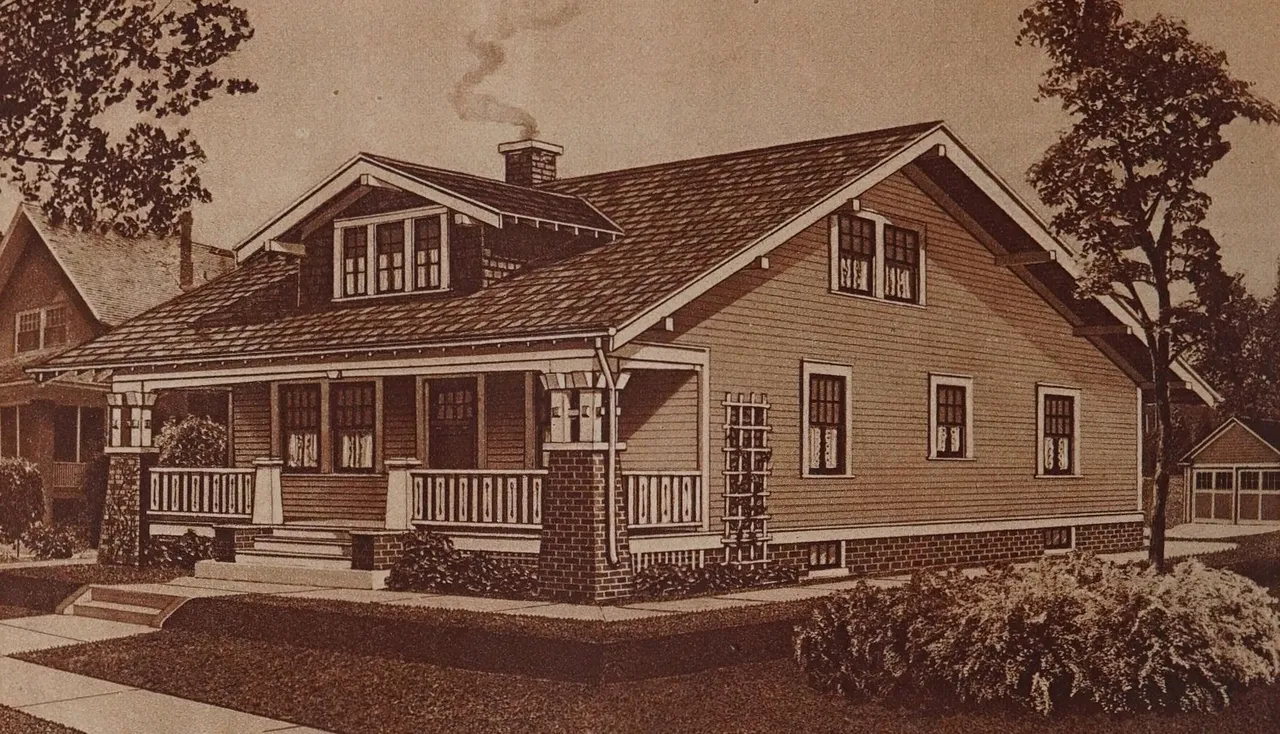
Sears sold houses through its catalogs from 1908 to 1940. To tell if yours is one, look for stamped lumber, shipping labels on the back of trim and old Sears paperwork, then match the house to a catalog design. Even Sears said you can’t prove it absolutely.
Sears kept no register of the houses it sold. When owners wrote to the Sears archives to ask about one, the archivists had no sales records to check it against. So the proof has to come from the house itself and from its old papers.
How to tell if your house is one
Short of Sears paperwork, no one clue is enough, and most of them trace back to the way Sears made these houses. From 1916 the framing lumber was cut to size at the factory and numbered to match the plans. The doors and trim came from a Sears mill, sometimes with the shipping label still on the back. The Sears archivists and the volunteers at searshouses.com both look for several clues, and you can check them in this order:
- Start with the bare framing. In the basement or the attic, look on the joists and rafters for a stamp of one letter and three digits, such as “A388.” Lara Solonickne, who studies Sears houses around Chicago, says that’s how Sears typically marked its precut framing after 1916. She has also seen Sears houses with other marks or none, and from about 1939 most had handwritten marks instead. Lumber mills have marked boards since about 1900, and other kit companies stamped theirs too, so the volunteers count a stamp only when the house also matches a Sears model. A house with no stamps can still be a Sears, because Sears urged some builders to buy their lumber nearby and save.
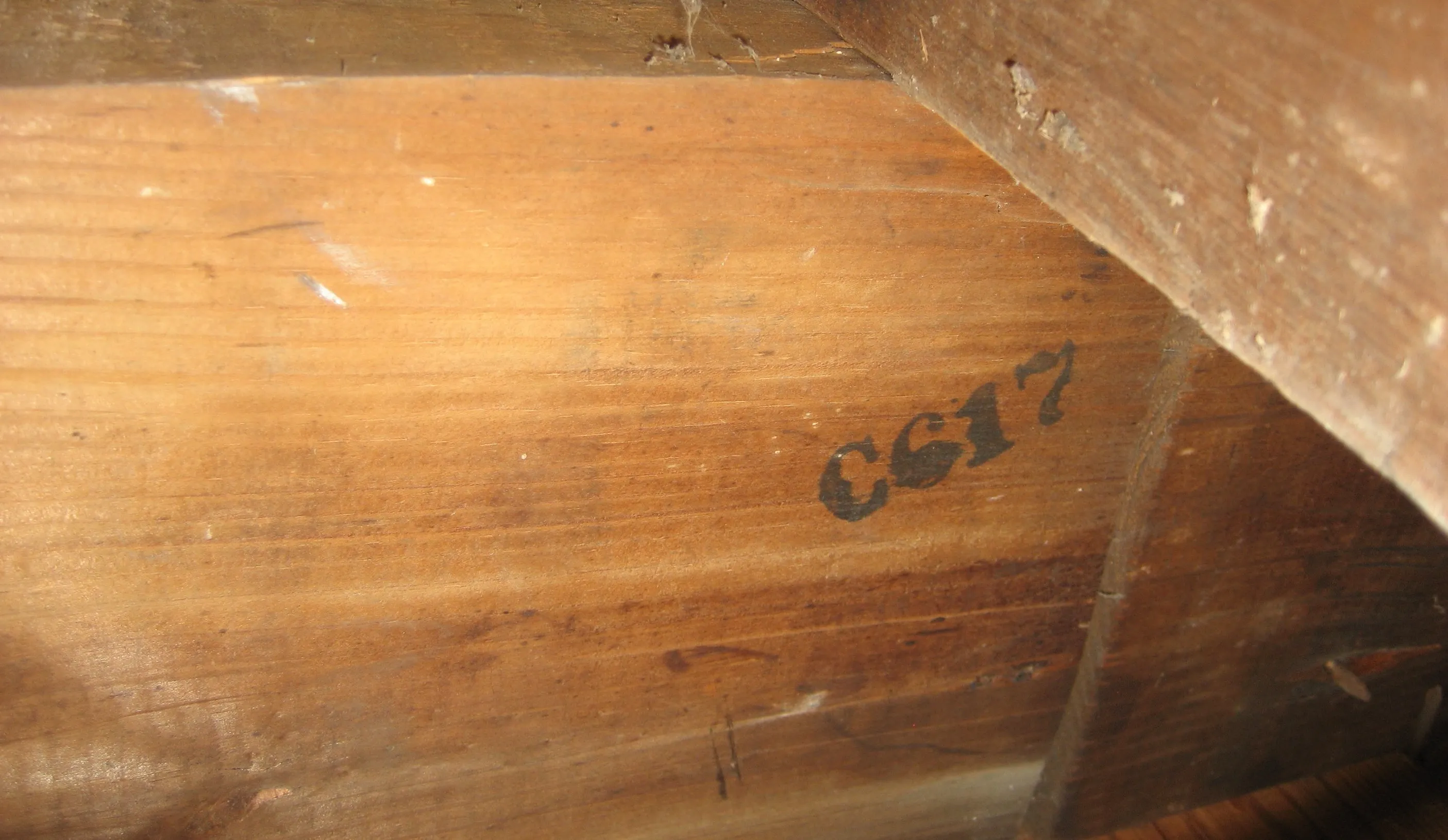
Stamped framing lumber in a Sears catalog house. Photo by Rosemary Thornton, public domain, via Wikimedia Commons.

- Check the back of the trim. Wherever a baseboard or a piece of door or window trim has come off, look on its back for a shipping label. The volunteers say it may read Sears, or Norwood Sash & Door, or just give an address on Homan Avenue in Chicago. Norwood, Ohio, was home to one of the plants Sears shipped doors and trim from. Sears’s archivist called a label “a good hint.” Your best chance, the archivist said, was to find its date and compare the house with that year’s catalog and the two before it.
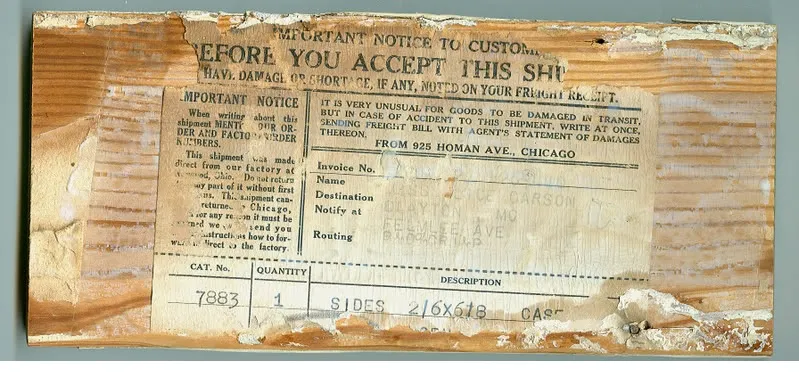
A Sears shipping label on millwork sent from the factory in Norwood, Ohio. Photo by Rosethornil, CC BY-SA 3.0, via Wikimedia Commons.

- Hunt for small Sears products. Goodwall is one, a Sears plaster that came in sheets and was nailed up like boards, sold in Sears’s house catalogs. A 2006 survey of kit houses in southeastern Virginia counts sheet plaster among the signs of a kit house, though of any brand. Rosemary Thornton, the author of several books on Sears houses, says 1930s Sears houses often have a little circled “SR” cast low in a corner of the bathtub or under the sink. We found that mark in no other source, and the volunteers don’t list it as evidence. Like any Sears product, a tub could also have been bought without the house.
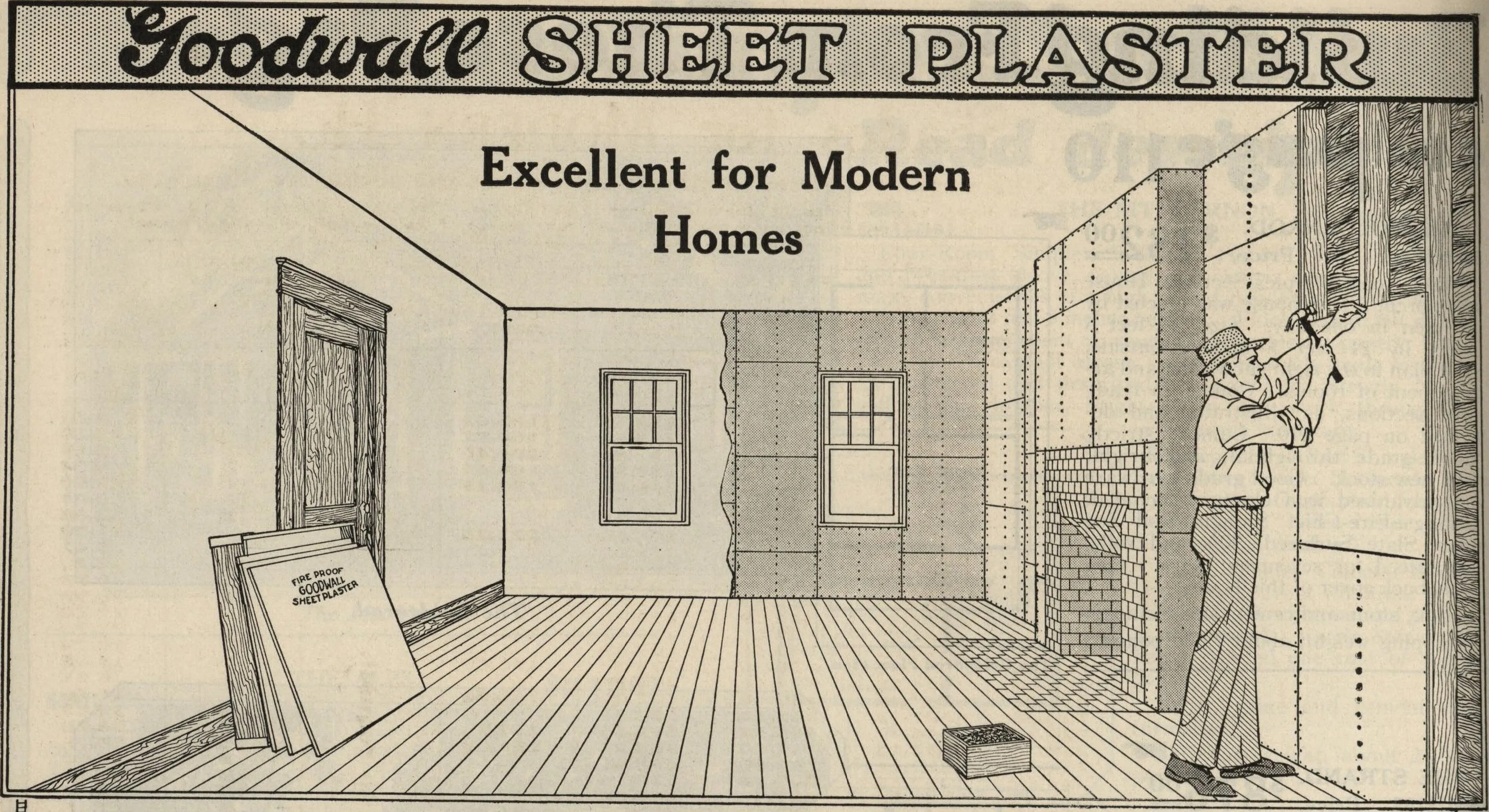
Goodwall sheet plaster in Sears’s 1921 Honor Bilt Modern Homes catalog, page 114. Public domain, via the Internet Archive.
-
Match the house to a catalog. Find the catalog design it might have come out of, and go by the windows. Buyers could flip the floor plan, add a dormer or pick brick instead of wood siding, so check the mirror image too. Later owners rarely moved the windows; their placement “rarely changed over time,” the same Virginia survey found, even when a house was heavily altered. You can read the catalogs free on the Internet Archive, from the 1908 book to the last one in 1940, floor plans and all.
-
Dig out the paperwork. A bill of sale, blueprints or the instruction booklet all help, the archivists said. Don’t count on Sears for copies, since its archives kept no file of blueprints and the catalogs never printed them. If the house was bought on Sears credit, though, there may be a mortgage or deed from Sears, and the volunteers count one as proof by itself. Sears lent money on its houses, off and on, from 1911 to 1933.
The volunteers are just as plain about what doesn’t count: a floor plan that looks like a catalog page, joist spacing, family lore, a railroad line nearby. Even Sears-stamped materials aren’t enough on their own, because Sears sold building materials for years before it sold houses.
Sears, or a look-alike?
If the clues say kit but not Sears, check the other companies. More than 75 companies, Sears among them, sold house plans by catalog between 1883 and 1951. Kit houses of every brand together made up only about 2 to 5 percent of the new houses of the 1920s, and Sears had to share even that.
Two of the rivals worked the way Sears did. Aladdin, of Bay City, Mich., was selling precut, numbered houses in 1906, two years before Sears’s first house catalog. Gordon-Van Tine, of Davenport, Iowa, began selling precut houses in 1916, the year Sears did. From 1922 on Ward’s Wardway houses were Gordon-Van Tine designs with new names and numbers.
When a reader wrote to the Sears archives about hardware stamped Aladdin, the answer was short: “your house is probably not a Sears Modern Home.” Another reader, who had found a Montgomery Ward label on the attic steps, was told the house might be a Ward catalog home.
What came in the mail
Sears’s first house catalog, in 1908, didn’t sell a kit at all. It showed 22 designs priced from $650 to $2,500, and those prices were Sears’s estimate for the whole job, labor and masonry included.
Instead the buyer got the plans free, with a list of all the material the house would take. Sears sold the millwork, meaning the doors, windows and interior trim, straight from the factory, and from 1909 it shipped the material for a whole house.
The kit most people picture came seven years after that, in 1916, when the catalog started selling “MACHINE MADE ‘ALREADY CUT’ HOUSES.” That spared the carpenter on your lot from measuring and cutting every board. The catalog explained: “Every piece of lumber shown in these illustrations is numbered, so that it can be taken from the bundle without losing time in sorting. Every number corresponds with the number shown on the plans which we furnish.”
The carpenter matched those numbers to the plans, with a booklet of directions that came with each house. Sears claimed that in a test it ran in 1921, working that way saved 40 percent of the carpenter’s hours on a four-room house. It also figured that a “man of average abilities” could finish one of its houses in 90 days, the Federal Reserve Bank of Richmond reports.
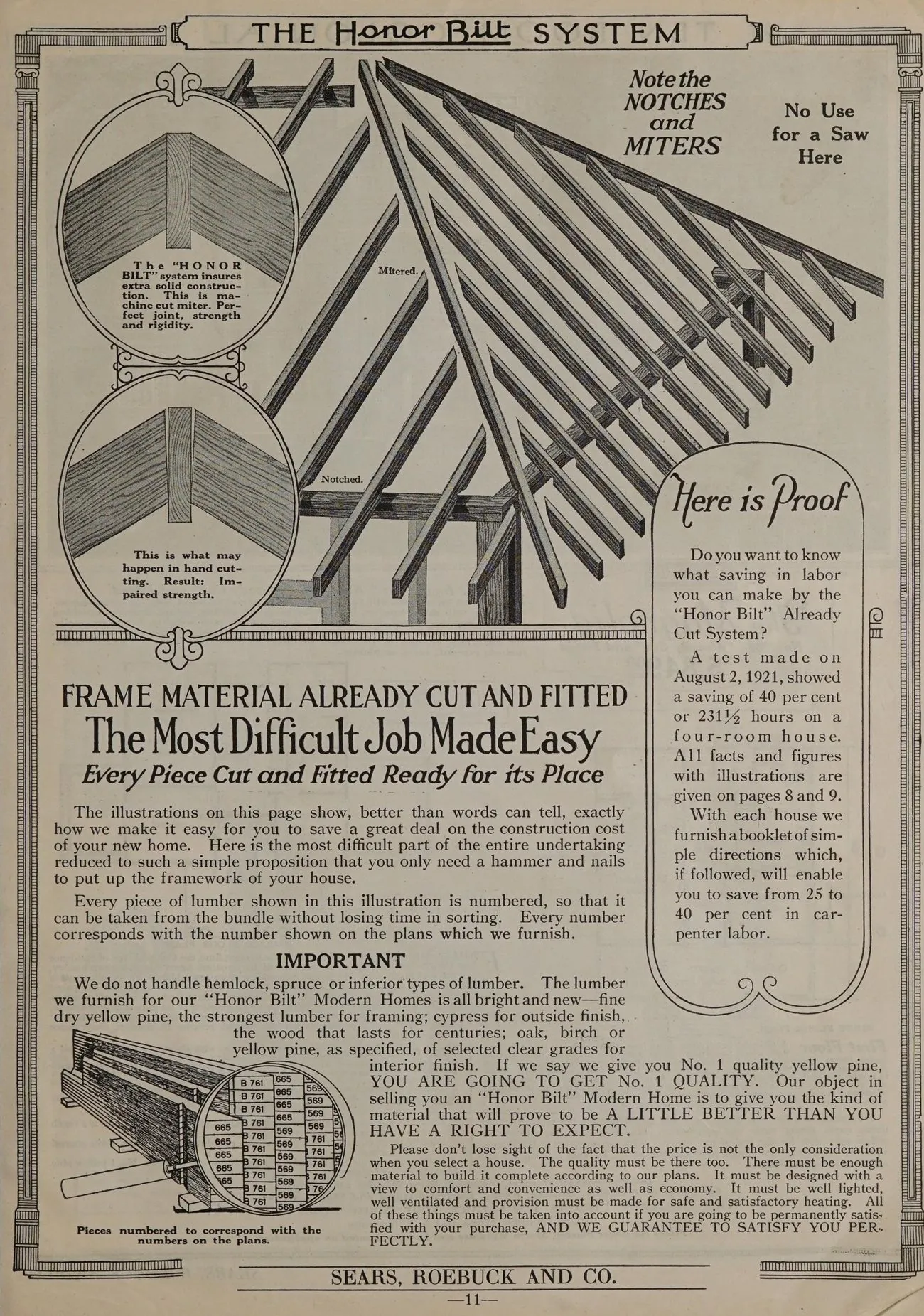
Sears’s 1922 Honor Bilt Modern Homes catalog, page 11. Public domain, via the Internet Archive.
Those numbered bundles came by rail, ahead of the rest of the house. “Unless otherwise instructed we ship lumber, nails and outside frames first,” the 1921 catalog said. Doors and inside finish followed, once the roof was on and there was a dry place to keep them. In 1921 the lumber went out from yards in southern Illinois and the millwork from a factory in southern Ohio. By the 1930s Sears had plants in Cairo, Ill., Norwood, Ohio, Mansfield, La., and Newark, N.J.
Rebecca Hunter, an architectural historian, imagines a letter saying the house will arrive in three days and ending, “Go down to the depot and unload your box car.” Buyers unloaded it themselves and hauled it all to the lot over several days, by automobile if they were lucky, the Richmond Fed’s history says. For the Chelsea, Modern Home No. 111, the materials included 25 doors, 28 windows, 750 pounds of nails and six dozen coat hooks. How many boxcars a house filled, or how many pieces were in it, no catalog or Sears archive page we read says.
What a Sears house cost
From 1916 on, the price in the catalog bought the kit and nothing more. “Price does not include cement, brick or plaster,” the 1920s catalogs said under each house, and plumbing, heating and wiring had their own price pages. The lot and the carpenter came on top of that.
Built and finished, a house could cost more than twice its kit price. The Magnolia, which Sears likened to Longfellow’s house in Cambridge, Mass., had four bedrooms, two baths and a sleeping porch. In the 1922 catalog its precut materials cost $5,849, and built complete, with heating, plumbing, wiring “and ALL labor,” it came to $15,000.
Even the kit price moved from catalog to catalog. The Vallonia, a bungalow that “has been built in hundreds of localities,” the 1926 catalog said, went like this:
| Year | Vallonia kit | In today’s money |
|---|---|---|
| 1920 | $2,998 | about $50,500 |
| 1921 | $1,668 | about $31,400 |
| 1926 | $2,076 | about $39,500 |
| 1938 | $1,611 | about $38,500 |
The 1938 kit cost a little less than the 1921 one and still comes out higher after inflation. That’s because prices in general fell in between, in the early ’20s and again in the Depression. By the government’s consumer price index, what cost $100 in 1921 cost about $79 in 1938.
We took the 1920 price from the 1921 catalog, which printed old and new prices side by side. The new ones, it said, were “more than 40 per cent lower than our 1920 prices.” It also sold on credit. “A small payment each month as you would pay rent makes you the owner of a good home in a few years,” it said.
A typical Sears loan asked a quarter down and ran five years, sometimes stretched to 15. In the 1930 catalog the long term was the plan itself, a 15-year mortgage with payments “as low as $25.00” a month (about $500 now). Nothing was due the first four months.
That same catalog printed no house prices at all, which is why the table has no row for the early 1930s. Labor and freight varied too much from town to town, it said, so the way it worked, you filled in a form and Sears sent back a delivered price. By 1934 prices were back, on a separate list enclosed with the catalog, and the 1938 price list left freight out.
When did Sears stop selling houses?
Sears printed its last house catalog in 1940, and its archive gives 1940 as the year it sold its last house. Andrew Mutch and his wife, Wendy, blog about kit houses. He kept finding Sears ads and notices in 1941 newspapers, and one as late as February 1942. A Sears house built in 1941, or even early 1942, isn’t ruled out.
Those last houses came from a business Sears had cut back in the 1930s. The trouble, as you might guess, started in 1929, the program’s best year. Nearly half of that year’s sales were still owed to Sears on mortgages when the stock market crashed. Sears stopped making house loans in 1933, and a year later it shut the department and closed out $11 million in mortgages. When it reopened in 1935, it sold houses only, with no loans and no help building them.
What finally ended it is still argued. Solonickne says wartime limits on lumber stopped it, “not because the business was failing,” while the company’s own history says the program was doomed after the crash.
How many Sears houses were built
Nobody knows exactly, but the figure to use is about 70,000 to 75,000 houses from 1908 to 1940. It’s the number on the Sears archive’s page about its houses, and the Richmond Fed uses it too.
The higher counts, 100,000 and up, are Sears’s own sales claims, printed in its catalogs from 1934 on and on two pages of its archive website. They’re hard to square with the chronology’s own entry for 1929, “nearly 49,000 units” sold to that point, just before sales fell off. The lowest, 60,000 to 70,000, is from a table in a National Register nomination, worked out from catalog figures and yearly sales reports.
Rebuilding the list, house by house
The list that exists today began with a third-grade history project. Solonickne’s daughter wanted photos of Sears houses near Chicago for her exhibit, and the local historical societies had a few leads but no list of addresses. Sears’s own list, started on its archive website, held one house from their area, without a street address. Mother and daughter came up with photos of five houses, and Solonickne put them on a free website, where owners started writing to her about theirs.
Researchers around the country were gathering addresses too. They agreed to keep them in one place, a national database that Solonickne called “just a simple spreadsheet, but it’s better than nothing.” The group behind it runs searshouses.com today.
Judith Chabot, a retired teacher in the St. Louis area, is one of them, and she calls the hunt “kind of like bird-watching.” She also pores over old mortgage records, which is one of the ways the group has found a lot of its Sears houses. By 2019 all that hunting had turned up more Sears houses in Ohio than in any other state, about 2,500, with Illinois next.
The list had passed 18,000 houses by 2024, not all of them confirmed. A house goes on it once the team agrees it is very likely the model it looks like. To count as authenticated, it needs a primary source, such as a Sears mortgage, a building permit or Sears blueprints.
Mutch crunches the team’s numbers from time to time, and he has estimated that about 70 percent of the houses Sears shipped are still standing. If he’s right, something like 50,000 Sears houses are still out there, and most of them aren’t on the list yet.
If yours might be one of them, the group will take a look. It keeps its database mostly private but answers owners’ questions, and its Contact page asks for the address and for what makes you think it’s a Sears. With the address they can find the house on Google Street View or in a real estate listing.
Questions people ask
Is a Sears house worth more than other old houses?
Not that anyone has shown. We found no study, only stories from real estate agents. One agent told The Philadelphia Inquirer in 2021 that Sears houses are well built, but “Location usually comes first.”
Did Sears build the houses?
The buyer did, or hired a carpenter, working from Sears’s plans and a booklet of directions. From 1929 Sears also offered to supervise construction, and in 1933 it cut that back to the New York City area.
How many designs did Sears offer?
447 over the years, by the company’s own count, from the multistory Ivanhoe down to the Goldenrod, a three-room summer cottage with no bath.
Were Sears houses shipped by train?
Yes. The few freight receipts Sears kept name the Texas & Pacific, the Santa Fe, the St. Louis Southwestern and the Baltimore & Ohio. The 1921 easy payment plan shipped “freight prepaid to your station.” The 1938 prices left freight out.
Written by Wance Payton, Oct. 26, 2026
28 sourcesWhere these facts come from
- Sears Archives, "What is a Sears Modern Home?" (archived copy)
- Sears Archives, "Chronology of homes" (archived copy)
- Sears Archives, "History of homes" (archived copy)
- Sears Archives, "Homes Q&A" (archived copy)
- Sears, Roebuck and Co., Our Book of Modern Homes, 4th edition, 1908
- Sears, Roebuck and Co., Honor Bilt Homes, 1916
- Sears, Roebuck and Co., Honor Bilt Modern Homes, 1921
- Sears, Roebuck and Co., Honor Bilt Modern Homes, 1922
- Sears, Roebuck and Co., Honor Bilt Modern Homes, 1926
- Sears, Roebuck and Co., Honor Bilt Modern Homes, 1930
- Sears, Roebuck and Co., Modern Homes, 1934
- Sears, Roebuck and Co., Modern Homes, 1936
- Sears, Roebuck and Co., Modern Homes, 1938
- Jessie Romero, "The House Is in the Mail," Econ Focus, Federal Reserve Bank of Richmond, 2019
- National Register of Historic Places, Gordon-Van Tine Company Historic District, Davenport, Iowa, 2017
- Meg Greene, The Kit House in Southeastern Virginia, College of William and Mary, 2006
- Sears Houses (searshouses.com), "Authenticating"
- Sears Houses (searshouses.com), "National List"
- Sears Houses (searshouses.com), "Contact"
- Sears Houses (searshouses.com), "Education & Information"
- Lara Solonickne, Sears Homes of Chicagoland, "Does stamped lumber mean house is Sears?", 2018
- Lara Solonickne, Sears Homes of Chicagoland, "Why did Sears stop selling houses?", 2016
- Rosemary Thornton, "Identifying Sears Homes"
- Lara Solonickne, Sears Homes of Chicagoland, "Where's the List?", 2015 (archived copy)
- Andrew Mutch, Kit House Hunters, "Revisiting the history of the final years of Sears Modern Homes", 2018
- Kevin Riordan, The Philadelphia Inquirer, June 9, 2021
- Maria Hollenhorst, "Inside the mind of a Sears house hunter," Marketplace, Sept. 9, 2024
- U.S. Bureau of Labor Statistics, Consumer Price Index (CPI-U)