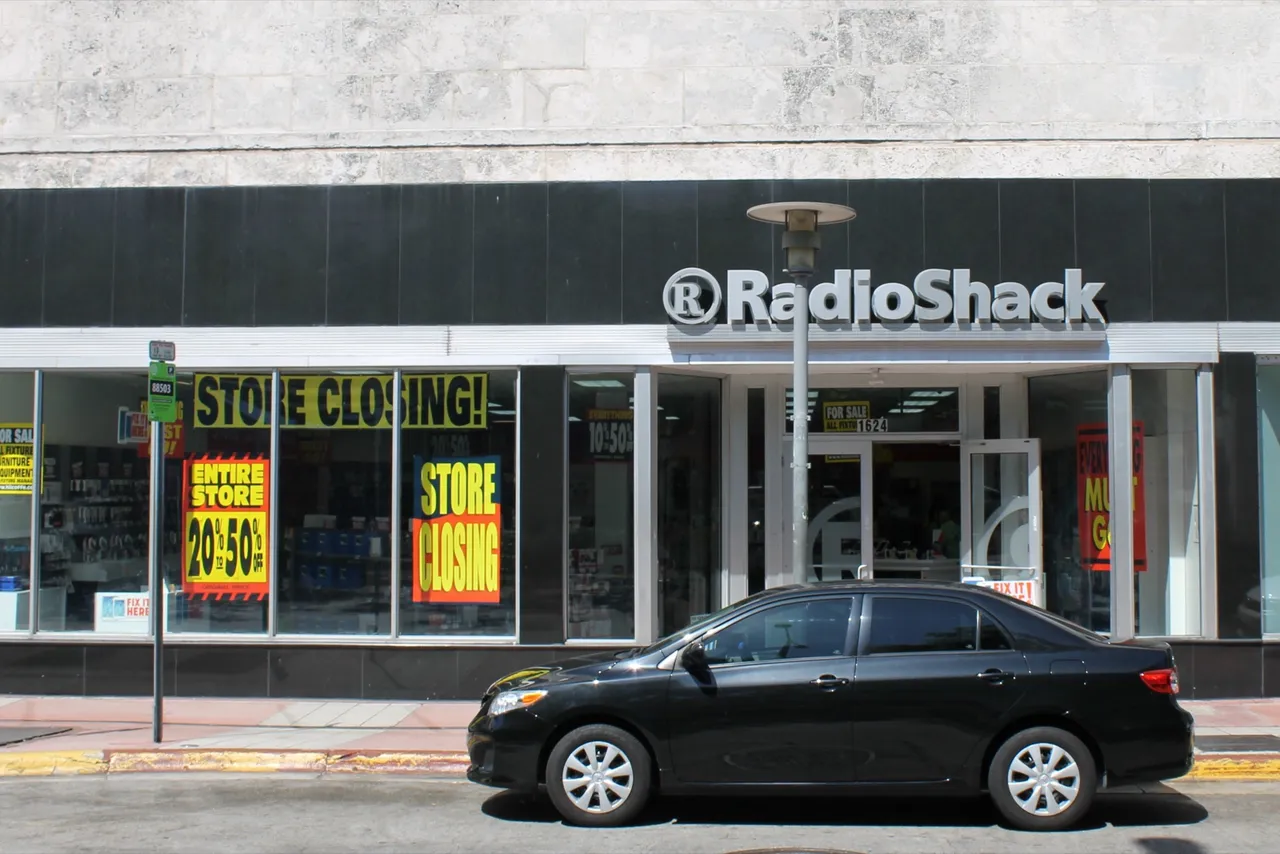
Woolworth’s was the five-and-ten Frank Woolworth started in 1879, and its last U.S. stores closed in 1997. The company behind them became Foot Locker, part of DICK’S Sporting Goods since September 2025. The Greensboro, N.C., store where the 1960 sit-in began is now a civil rights museum, and a section of its lunch counter is at the Smithsonian.
Frank Woolworth opened a “tumble down” store at 170 North Queen Street in Lancaster, Pa., on June 21, 1879, without a word of advertising. “I had 7 clerks and they had to work, you bet,” he wrote to his father the next day. By closing time on that first day they had made 2,553 nickel sales.
He was 27 and had already tried once. As a clerk in a Watertown, N.Y., dry-goods store he’d set up a five-cent counter on two old sewing tables for the opening day of the county fair. “Like magic, the goods faded away,” he said later. His own first store, on a side street in Utica, lasted only a few months.
Lancaster was the one that took, and by the next summer the sign over the door read “5 and 10 Cent Store.” When he died in 1919 there were 1,081 Woolworth stores. The last U.S. five-and-dimes under his name closed in November 1997, and the company that ran them is called Foot Locker now.
Lunch at the five-and-ten
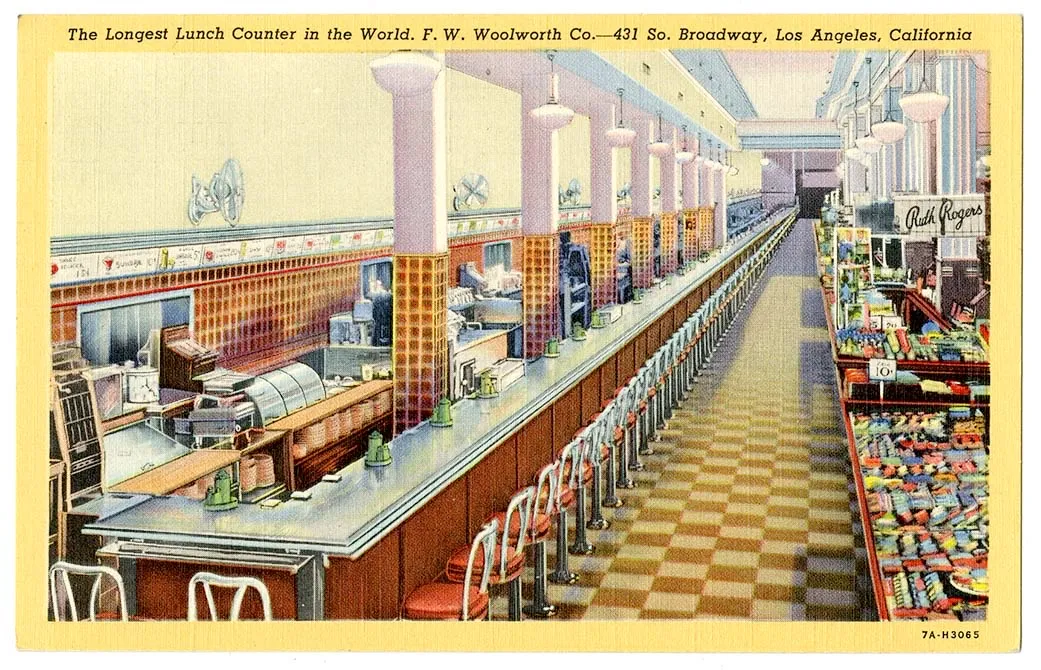
Woolworth’s started selling food in 1911, according to the company’s own centennial history, with hot dogs and root beer drawn from “a huge oak barrel atop the counter.” By 1940 more than 800 stores served lunch every day.
That year’s menu went on the last pages of the annual report, under the line “Woolworth Invites You to Luncheon.” The big plate was roast young turkey with giblet gravy and celery dressing, cranberry sauce, string beans and creamy whipped potatoes, and a hot cloverleaf roll and butter, for a quarter. Chicken pot pie, “a meal in itself,” was a nickel less. “How is Woolworth able to serve a meal like this at a profit for 25¢?” the page asked. The answer was a set of four rules, the second “Serve only the sure sellers” and the last to keep prices low enough to draw crowds.
At the new Tampa store in 1941, each seat at the stainless steel counter had a back rest, upholstery and a rack for a shopper’s parcels and handbag.
Placed end to end, the 1959 annual report figured, the company’s food counters “would stretch continuously for 22.5 miles.” Customers almost everywhere, it added, expected to find one in their Woolworth’s.
Greensboro, Feb. 1, 1960
The Woolworth’s on Elm Street in Greensboro, N.C., had a lunch counter with 65 seats, and Black customers could eat only at a stand-up counter. Behind the counter, Black employees cooked, cleaned and washed dishes. The waitresses and the customers were all white.
Late on the afternoon of Feb. 1, four freshmen from North Carolina A&T walked about 15 minutes from the college’s Bluford Library to the store. They were 17 and 18: Ezell Blair Jr., now Jibreel Khazan, Franklin McCain, Joseph McNeil and David Richmond. They bought a few small things elsewhere in the store and kept the receipts. Then they sat down at the counter and asked for coffee.
Charles Bess was working the counter. As he told it, the woman on the sandwich board said to them, “We don’t serve colored folks here.” Other accounts say she was one of the store’s Black employees. Asked in 1979 what it had felt like to sit there, McNeil said, “Intense sense of pride, a bit of trepidation.” Two older white women, in Khazan’s telling, came over to tell them they were doing right. Nobody served them, and they sat until the store closed.
The next day they came back with more students. More came every day after that, and on the third day students held 63 of the 65 seats. By April there had been sit-ins in more than 70 Southern cities.
Woolworth’s annual report for 1960 mentioned it once, in the president’s letter. It spoke of an “interruption of normal shopping patterns in some communities as a result of local actions taken in the interest of desegregating eating facilities in certain Southern communities.” Later accounts put the cost of the demonstrations at about $200,000 in lost sales in 1960.
July 25, 1960: three women from the kitchen
Geneva Tisdale had worked at the Elm Street store since 1951, when she started as a “fountain girl.” She was pregnant in 1960 and was sent home during the sit-ins.
The counter opened to Black customers on July 25. Tisdale’s supervisor at the luncheonette, Ms. Holt, wanted her own staff to go first. “I want my girls to be the first to sit at the counter,” Tisdale remembered her saying.
So the three of them, Tisdale, Suzie Morrison and Anita Jones, went upstairs and changed into dress clothes. They’d been told to come back down and walk around the store first, like they were out shopping. “Have your big bag and all.”
They sat apart from each other at the counter. Tisdale had an egg-salad sandwich. “I swallowed it,” she said. “It took me about five minutes, I’m sure — no longer, no more than ten.” Then they went back upstairs to change.
Why it faded, and the counters that closed first
A retail consultant, Kurt Barnard, told the Honolulu Star-Bulletin in 1997 that the five-and-dime business had been “defunct for at least 25 years.” It “lost reason for its being,” he said, “with discount and specialty stores taking over its function.”
Woolworth’s had tried a discount chain of its own. Woolco opened its first store in Columbus, Ohio, in 1962, and in 1982 the company gave up on its U.S. Woolco stores.
But the five-and-tens themselves stayed open a while longer. In October 1993 the company marked about 970 of its stores, of every kind, for closing or conversion to other formats. Among its U.S. Woolworth five-and-tens, it closed about half, approximately 400. By 1996 the ones still open were losing money.
The Greensboro counter served its last meals that October. David Isay was there on the last afternoon for an NPR report. He found a single straight counter along one wall and a row of horseshoe-shaped counters along the other. The day’s special, liver and onions at $2.99, was on a sign hung on gold chains above the take-out counter.
Tisdale was still there, after more than 40 years. Asked what she made an hour, she told him, “Five fifty.” On Monday, the report said, she would move out onto the store floor and work there until the store itself closed.
Bremerton, Wash., lost its counter the same month. Signs read “Close Out Specials. All pie 99 cents. Thanks for the memories.” The stools were red Naugahyde swivel chairs at a chrome-trimmed counter, and the Good Morning Breakfast Special got you two eggs and two strips of bacon with hash browns and toast.
Thelma Wills, 82, had come in every day at 3 o’clock for years, a four-mile walk there and back, and her mother and two sisters had been Woolworth clerks in the ’20s. Ettamay Strang had waited on that counter for 22 years, and another waitress said she was famous for her tartar sauce.
Anyone over 45, a shipyard systems manager named Ken Hagar told The Seattle Times, remembered when there were a lot of lunch counters, and they “had the original fast food.” He also wanted to know, “Where else can you go to eat, have your picture taken and buy a canary before you leave?”
The same 1940 menu had a banana split at a dime and coffee with cream at a nickel. After inflation, the turkey dinner comes to about $6, roughly a dollar less than the Greensboro liver and onions in 1993.
| Item | Year | Price then | In today’s money |
|---|---|---|---|
| Roast turkey dinner | 1940 | $0.25 | $6.01 |
| Chicken pot pie | 1940 | $0.20 | $4.81 |
| Banana split | 1940 | $0.10 | $2.41 |
| Coffee with cream | 1940 | $0.05 | $1.20 |
| Liver and onions, Greensboro | 1993 | $2.99 | $6.97 |
| Breakfast special, Bremerton | 1993 | $2.50 | $5.83 |
| Pie, closing week, Bremerton | 1993 | $0.99 | $2.31 |
1940 prices from Woolworth’s annual report; 1993 prices from NPR and The Seattle Times. Today’s money uses the Bureau of Labor Statistics consumer price index through September 2026.
1997, and how Woolworth’s became Foot Locker
Woolworth Corporation announced on July 17, 1997, that it would close its U.S. Woolworth’s stores, the 400 still running under the F.W. Woolworth name. Its chairman, Roger Farah, said the marketplace “simply could not support Woolworth’s form of general merchandise business at an acceptable return on investment.” The press release said the display cases, soda fountain items, signs and furniture would be offered for sale.
In Honolulu, Vivian Deyonot went to the downtown store every day for a soda and to talk story with friends. “I don’t know what I’ll do,” she told the Star-Bulletin outside the Fort Street Mall Woolworth’s that morning.
The last U.S. stores closed that November. About a hundred of the best locations were to become Foot Locker, Champs and other shops the company owned.
The company renamed itself Venator Group in 1998, after a classical word for “sportsman,” and became Foot Locker, Inc. in 2001. On the government’s books it never stopped being one company: the filings in 1997, 1998 and 2001 all carry the same SEC file number, 1-10299. Since Sept. 8, 2025, Foot Locker has been part of DICK’S Sporting Goods.
Where to see the Greensboro counter
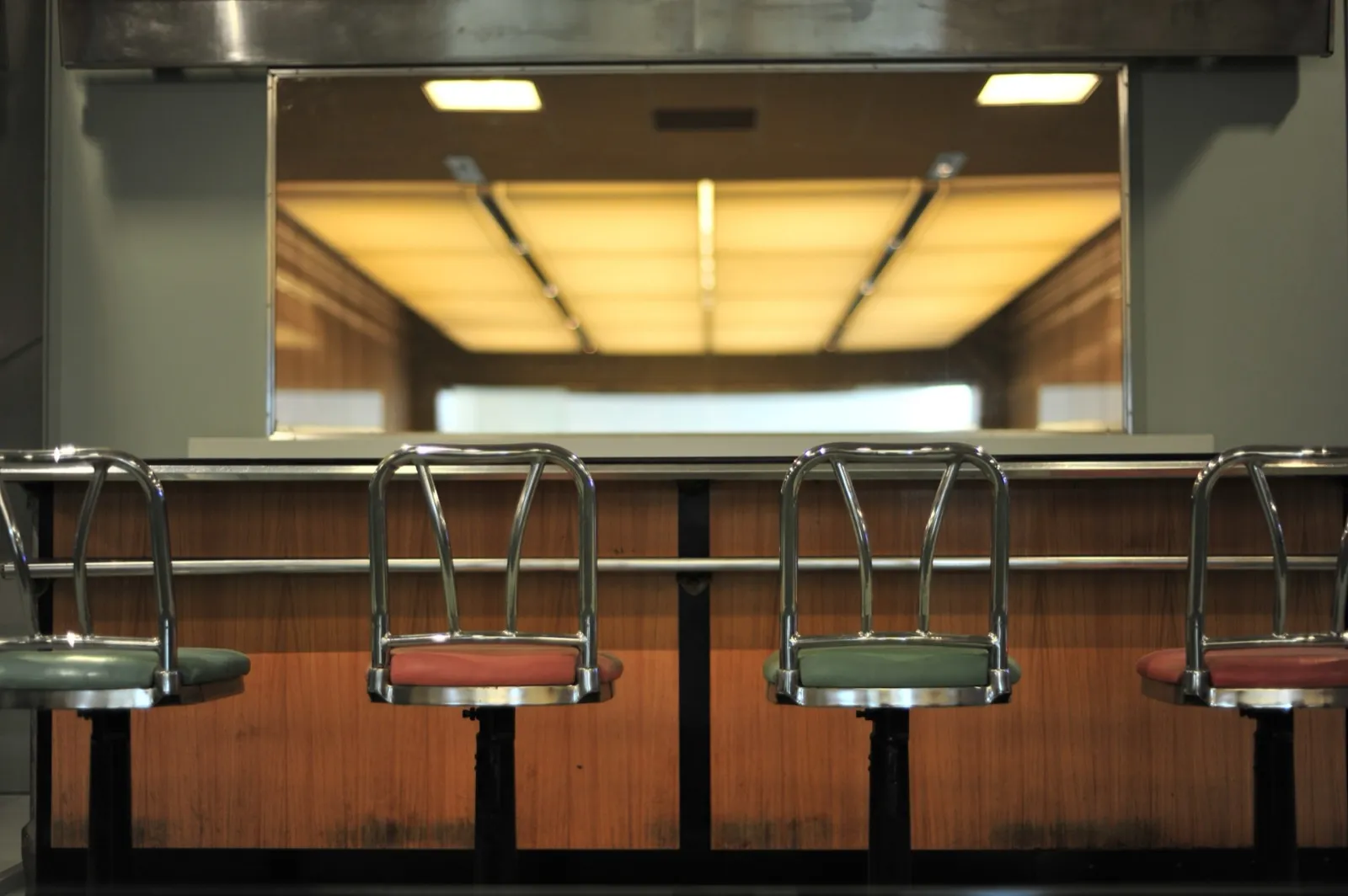
The section of the Greensboro counter at the National Museum of American History, 2010. Photo by Eric Chan, CC BY 2.0, via Wikimedia Commons.
The Smithsonian’s curators asked for four stools and an eight-foot section of the counter, and members of a Greensboro carpenters’ union gave their labor to take it out. The National Museum of American History in Washington dedicated it on Jan. 14, 1995.
Back in Greensboro the building was close to being torn down in 1994 when Skip Alston and Earl Jones, a city councilman at the time, stepped in to buy it. It opened as the International Civil Rights Center & Museum, at 134 S. Elm St., on Feb. 1, 2010, 50 years to the day after the four sat down. “This museum exists because there was the time that we don’t want to go back to,” Franklin McCain told NPR as the museum was about to open.
Inside, the old counter room was left much as it had been. On opening day a black counter stretched across the whole room, with a row of metal stools along it, their cushions red and green vinyl.
Questions people ask
Was the first Woolworth’s in Utica or Lancaster?
Both have a claim. Frank Woolworth opened “The Great Five Cent Store” in Utica, N.Y., on Feb. 22, 1879, but the small shop on a side street closed within a few months. The store he opened in Lancaster, Pa., on June 21, 1879, was the one that lasted, and by the next summer it had become a five-and-ten. In Watertown, N.Y., where he set up his first five-cent counter as a clerk, the Woolworth store carried a sign calling it “The Birthplace of the 5 and 10c Business.”
When did Woolworth’s stop being a five-and-ten?
In stages. In 1932 the company added a line of goods at 20 cents, and in 1935 its board dropped price limits altogether. By 1967 Woolworth’s called itself the world’s largest seller of phonograph records, from Bach to the Beatles, and probably of electric guitars too.
Was Woolworths in Britain the same company?
Not after 1982. Until then the American company owned 52.6% of the British chain, F. W. Woolworth plc, and that year it announced it would sell its entire stake. From then on the two were separate businesses.
What was Woolco?
Woolworth’s own discount chain. The first Woolco opened in Columbus, Ohio, in 1962, and in September 1982 the company decided to close its U.S. Woolco stores.
Written by Wance Payton, Oct. 15, 2026
28 sourcesWhere these facts come from
- F. W. Woolworth Co., 1979 annual report (centennial issue): chronology, company history, Frank Woolworth's letter of June 22, 1879, and "Food Service Operations"
- F. W. Woolworth Co., annual reports 1924–1952 (University of Illinois copy): 1932 report, 1939 "Woolworth's Home Town," 1940 closing pages "Woolworth Invites You to Luncheon," 1941 report
- F. W. Woolworth Co., annual report for 1959 ("Food and Still More Food")
- F. W. Woolworth Co., annual report for 1960, president's letter
- F. W. Woolworth Co., Report of Annual Meeting of Stockholders, May 17, 1967
- F. W. Woolworth Co., 1982 annual report; Woolworth Corporation, 1993 and 1997 annual reports; Venator Group, 1998 annual report
- NYC Landmarks Preservation Commission, "Woolworth Building," designation report LP-1273, April 12, 1983
- William Yeingst and Lonnie Bunch, "Sitting for Justice," National Museum of American History, 1996
- The Object of History: The Lunch Counter, National Museum of American History and the Roy Rosenzweig Center for History and New Media (Charles Bess, 1984)
- The Object of History: The Lunch Counter (Joseph McNeil, interview with Eugene Pfaff, Oct. 14, 1979)
- The Object of History: The Lunch Counter (Jibreel Khazan at the Smithsonian dedication, Jan. 14, 1995)
- The Object of History: The Lunch Counter (Geneva Tisdale, 1998)
- Jason Alston, "Greensboro Sit-Ins at Woolworth's, February–July 1960," Civil Rights Greensboro, UNC Greensboro Libraries
- Alexander R. Stoesen, "Greensboro Sit-Ins," NCpedia, 2006
- N. S. Gardner et al., "Standing Their Ground: The Sit-In at the Greensboro Woolworth's Store," NCpedia, 2025
- North Carolina Highway Historical Marker J-79, "Sit-Ins," N.C. Department of Natural and Cultural Resources
- Civil Rights Digital Library, "Tisdale, Geneva, 1933-"
- David Isay, "Woolworth's Lunch-Counter Waitress," All Things Considered, NPR, Oct. 23, 1993 (transcript, StoryCorps)
- U.S. Census Bureau, "History and the Census: The 1960 Greensboro Sit-In," February 2025
- Nancy Bartley, "The Counter Community," The Seattle Times, Oct. 22, 1993
- Woolworth Corporation, press release "Woolworth Corporation to Close Its U.S. General Merchandise Operations," Form 8-K, July 1997
- Rick Daysog, "Woolworth closing all isle stores," Honolulu Star-Bulletin, July 17, 1997
- Venator Group, Form 8-K (name change), June 1998
- Foot Locker, Inc., Form 8-K (name change), Nov. 1, 2001
- Foot Locker, Inc., Form 8-K (merger with DICK'S Sporting Goods), Sept. 8, 2025
- International Civil Rights Center & Museum (Sit-In Movement, Inc.), visitor information, 134 S. Elm St., Greensboro
- Jessica Jones, "Fifty Years Later, N.C. Sit-In Site Becomes Museum," Morning Edition, NPR, Feb. 1, 2010
- U.S. Bureau of Labor Statistics, Consumer Price Index for All Urban Consumers (CPI-U)