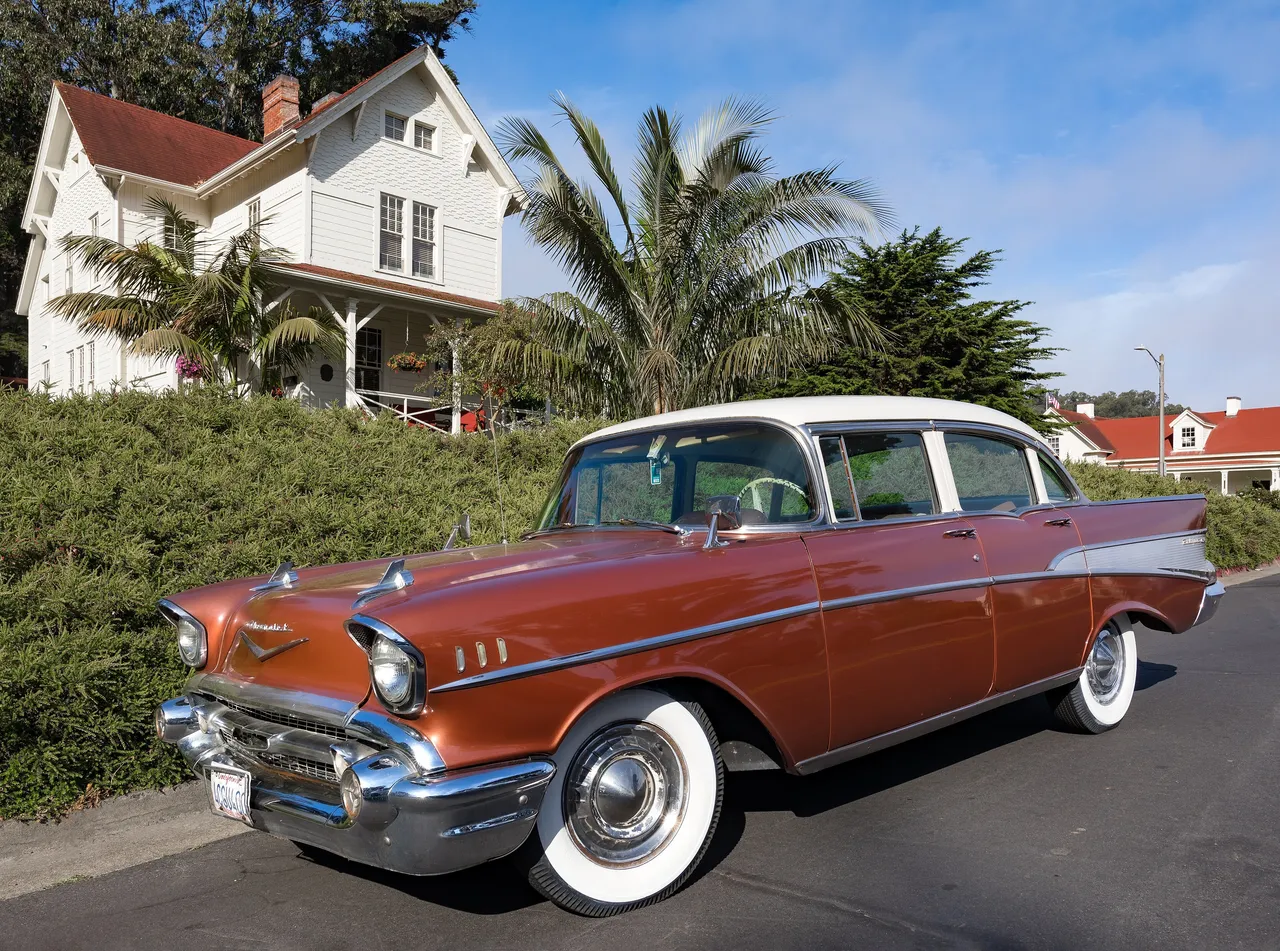
Chevrolet and Ford built close to half of the 7.95 million American cars made in 1955, the decade’s record year. That year a plain Chevrolet sedan cost about $1,700 delivered, a Thunderbird $2,944, and the average buyer paid $2,940. A 1959 Cadillac Eldorado Biarritz convertible cost $7,401. The decade also had the Corvette, the Rambler, the VW, the Hudson Hornet and the Edsel.
In April 1955, Warren Chevrolet Sales in Gettysburg, Pa., advertised a new Chevrolet “full 6-pass. sedan” for $1,695, “Delivered right here in Gettysburg,” with a promise of “NO HIGH PRESSURE SELLING.” Bronson Chevrolet in Lawrence, Mass., asked four dollars more and made up for it in words. Its $1,699 Chevrolet on the front page of the Andover Townsman that August was “Not for a Business Coupe but for a full size, 6 passenger, 2 door sedan.”
The 1955 to 1957 Chevrolet
The factory price lists that year had a Bel Air four-door at $1,932 with the six-cylinder engine, or $99 more with the V-8.
In Dearborn, Mich., The Henry Ford museum keeps a 1955 Bel Air hardtop in coral and smoke grey, from the year Chevy’s slogan was “The Hot One.” The museum also notes that convertibles drew people into the showroom but sedans took them home, and in 1956 only about 2.6% of Chevrolet buyers drove off in a ragtop.
Two years later, in December 1956, the 1957 Bel Air four-door was $2,262 delivered with the six, and the V-8 added $100. Popular Mechanics asked owners what they thought of their new cars and printed the answers in its Owners Reports, most of them signed with a state or town and a line of work. Chevrolet owners in the April 1957 report put the pickup first. Their ’57 “goes up hills like a mountain goat,” said a California actress, and a New York farmer figured, “If it had wings, it would take off.”
What bothered some of them was how big the car had grown. Asked whether they’d like it any longer, some owners said a longer one wouldn’t fit the garage, and a North Carolina textile worker put it plainest, “Would have to add on to garage.” As the body stretched out, the roof had come down, low enough that a Nebraska conductor found it “necessary to take off my hat” just to get in. A California housewife had a word on the styling, “Don’t let the fins go any higher.”
The 1957 Ford
When the 1957 Fords went on show in Hope, Ark., in early October 1956, the coffee was on the dealer. “Free coffee has been provided at your favorite cafe or drug store all during the day,” the Hope Star told its readers, with Hope Auto picking up the tab, and the Ford dealers had arranged free parking all over town. There were prizes too, with “nothing to buy, just see the new Ford.”
In 1957, Ford and Chevrolet ran neck and neck. Popular accounts say Ford outsold Chevrolet that year, a claim that would have to rest on model-year sales or registrations, since the calendar-year production count has Chevrolet ahead, and we found no model-year count from the time to check it against. The Automobile Manufacturers Association counted the cars built in the calendar year, and Chevrolet’s plants finished just 141 cars ahead, at about 1.5 million each. Popular Mechanics headed its March 1957 Ford report “Ford Is Long, Low And Owners Love It.”
“Everyone turns to look at the ’57 Ford. I am proud to own one,” a Florida clerk wrote. What a Kansas construction worker noticed was that the low-priced Ford had moved up in size. “Ford is no longer a Ford. It’s a big car with a big-car look.”
A New Jersey engineer thought the car cost too much for the way it was put together. “There should be a law against putting together a car like this and selling it for $3000.” His $3000 was about $700 above what a Fairlane 500 four-door listed at, $2,294.98 delivered with the six.
The station wagon
“Nine’s Fine!” said Ford’s ad for the 1957 Country Squire, “in the roomiest ridingest, powerfulest Ford Wagons ever!” The three-seat Squire cost $2,645.94 delivered. By 1955 the factories were selling about 759,000 station wagons a year, more than five times as many as in 1950.
Rambler wagon owners told Popular Mechanics in 1956 what went in the back, and for one Illinois owner the wagon had answered where to put the playpen and the dog. “On long trips,” an Illinois sales engineer wrote, “it’s a mobile playground for the baby.” The Rambler’s reclining seats made up into a bed, and an Ohio mechanic and his wife “slept in the car for 12 consecutive nights.”
Two seats: the Corvette and the Thunderbird
The Corvette came off the line in 1953 at a factory list price of $3,250, before federal excise tax and other charges, with the Powerglide automatic as standard equipment. “Stop Dreaming and Start Driving!” said a 1954 ad. Owners who wrote to Popular Mechanics that year were less dreamy about the weather. From an Ohio executive came “Strictly a dry-weather car. Floor holds four gallons of water.”
Ford built more than 16,000 Thunderbirds in the first model year. When the car came along in late 1954, Motor Trend announced it “at the startling low price of $2695,” with a hardtop and a four-way power seat but not the folding top, which was $70 extra. By February a reader in Portland, Ore., wrote in that a salesman there had quoted him “$1000 higher, stripped!” Its editors explained that $2,695 “was the first announced suggested price. The current base price on the Thunderbird hardtop is $2944.”
Fins and the 1959 Cadillac
The 1959 Cadillac Eldorado Biarritz convertible cost $7,401 delivered. It was the dearest car in the table, and the one a family had the most weeks of income to save up for. The Henry Ford says its designers drew on jet aircraft, from the swept-back fins to front parking lights that look like a B-52 bomber’s air intakes.
The man behind that look had said what he was after five years earlier. “My primary purpose for 28 years has been to lengthen and lower the American automobile,” Harley Earl wrote in The Saturday Evening Post in 1954. He had founded the Styling Section of General Motors, and he headed its 650 people. To his eye, “a greyhound is more graceful than an English bulldog.”
Earl’s fin came from the P-38 Lightning fighter. He was so excited by the plane when he first saw it that he arranged a viewing for his staff, and that viewing, he wrote, “blossomed out in the Cadillac fishtail fenders.”
A 1959 Buick fin turned out to be handy for a California auto body mechanic. When his car was hit from behind at the curb, “The left rear fin acted like a can opener on the other car.”
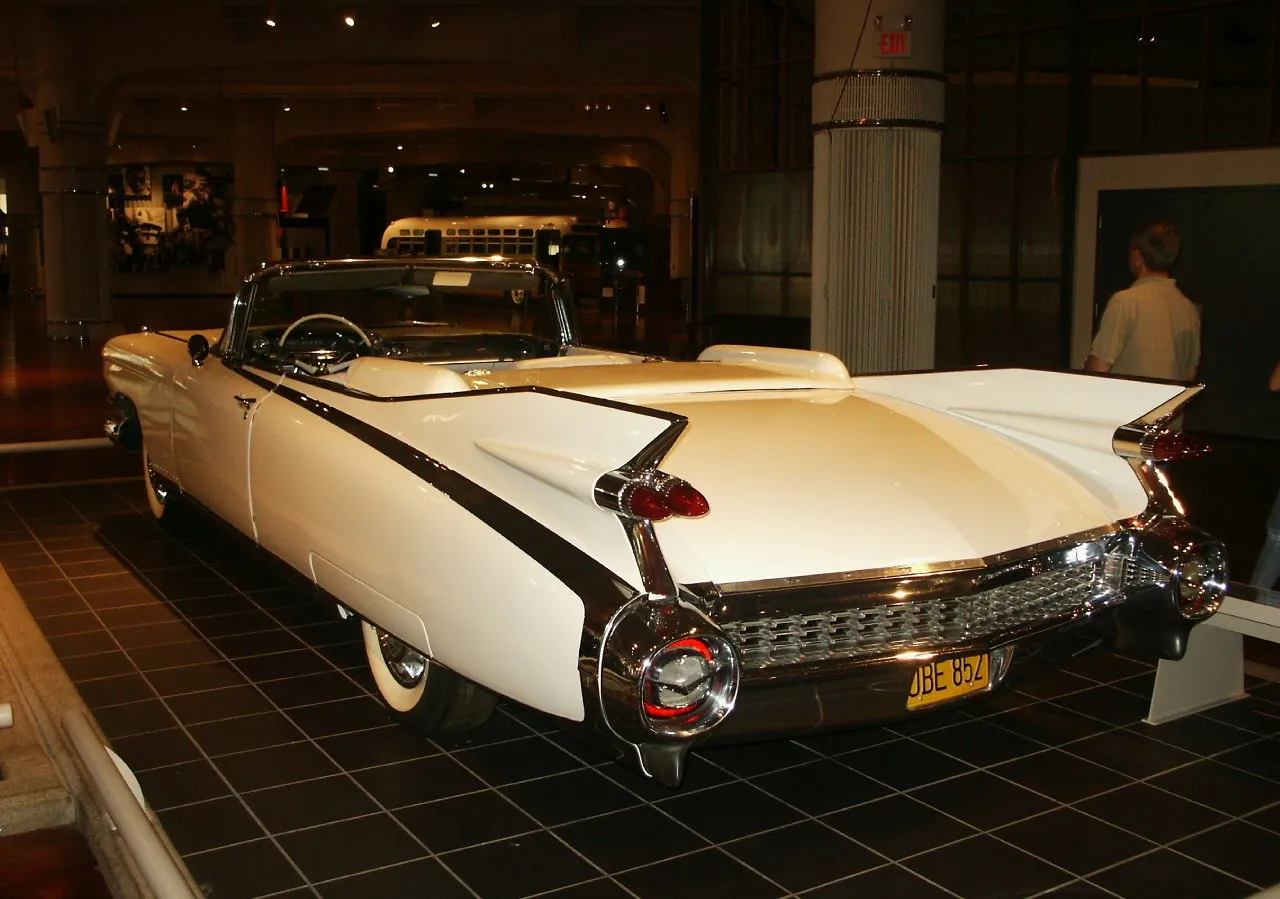
A 1959 Cadillac Eldorado Biarritz convertible at The Henry Ford museum in Dearborn, Mich., 2005. Photo by artistmac, CC BY-SA 2.0, via Wikimedia Commons.
The small cars: Rambler and Volkswagen
The Nash Rambler Custom convertible cost $1,808 delivered in the spring of 1950. A man in De Soto, Mo., told Popular Mechanics he liked everything about it “except the small trunk, did I say trunk?” A Californian figured, “if I ever run out of gas on level road I can easily push it two or three miles without getting very tired.”
“Cars 19 feet long, weighing two tons, are used to run a 118-pound housewife three blocks to the drugstore for a two-ounce package of bobby pins and lipstick,” George Romney of American Motors said in 1955, as The Henry Ford quotes him. By 1959 the plants were building 401,422 Ramblers a year, almost five times the 1955 count. A 1957 Rambler brochure had a title to match, “The Story of the Man Who Bought a Dinosaur.”
The Volkswagen looked like an insect, with its engine where the trunk should be and no radiator at all. Popular Mechanics opened its 1956 report by asking what there was about “this small, ugly, low-powered import” that “makes every owner talk like a salesman.” An ad in January 1957 priced it at $1,495 delivered in New York. By 1959 Americans were bringing in 668,070 new cars a year from abroad, more than 11 times the 1955 number. That count takes in every make from every country, and 205,799 of them came from West Germany.
An Ohio housewife admitted she was “scared to death to drive our full-size car, but I’ll try anything in the ‘bug’!” A New York carpenter and a friend parked his by nosing it in and lifting the back end over to the curb, “to the amusement of passers-by.”
Hudson, Studebaker and Packard
A 1952 Champion spark plug ad credited the Hudson Hornet with “36 VICTORIES IN 42 STARTS” in stock-car racing, its record to Sept. 1. When Popular Mechanics heard from Hudson owners in 1954, though, “only a fraction of one percent of the owners was influenced” by the racing record. A 1953 Hornet four-door cost $2,768.86 delivered, and the Hydra-Matic automatic was $178.03 more. A Westville, Ind., machinist worried about his passengers: “Step-down design gives my friends trouble getting out — especially old people.”
“More people have stopped and admired my car than any other I ever owned,” a Phoenix sales manager said of his 1953 Studebaker. A retired farmer in McCook, Neb., liked that it was “easy to wash and wax without a stepladder.”
By 1958 the Automobile Manufacturers Association’s production table doesn’t list a single Hudson or Nash, only Ramblers, and Packard built 1,745 cars that year and none in 1959. Studebaker lasted longer. Still building cars in 1959, 153,823 of them, the year of the Lark.
The Edsel
Ford introduced the Edsel on Sept. 4, 1957, after a run of teaser ads. At Hope Auto Co. in Hope, Ark., Franklin McLarty showed the new car that afternoon to what he and his father, Thomas F. McLarty, called a record crowd. The Edsel ad in that day’s paper asked, “What does an Edsel cost?” and answered, “Prices range from just above the lowest to just below the highest.”
In plain numbers that meant $2,519 delivered for a Ranger two-door sedan, up to $3,801 for a Citation convertible. The top-line Citation was over 18 feet long and came in 161 paint combinations. Edsel’s stylists said the grille echoed classic 1930s cars, and the crack The Henry Ford passes along is that it looked like “a Buick sucking a lemon.”
Ford built 54,607 Edsels in calendar 1957 and fewer than 30,000 in each of the next two years. The owners who did buy one gave Popular Mechanics its March 1958 headline, “Edsel Power, Handling Are Tops, Say Owners.”
A Texas drug salesman’s wife slept in the back seat through one of the roughest stretches of a detour, he wrote, and “even put polish on her nails” there “with no smears.” A South Dakota hatchery operator owned up about the grille. “At first people couldn’t get used to the grille. In fact, they didn’t like it, but as time goes on they are liking it more.”
What 1950s cars cost new
If your family bought a plain Chevrolet sedan in 1955, it took about 20 weeks of the typical family’s income, and a 1959 Eldorado Biarritz took 71. Unless a row says otherwise, the prices below come from the trade weekly Automotive News. Those are delivered prices, meaning the factory’s suggested price with federal tax and the factory and dealer handling charges, but no freight, state or local tax, or options. Today’s money uses the government’s consumer price index through September 2026, and both today’s money and the weeks of income are figured for the car’s model year.
| Car | Price new | Price from | In today’s money | Weeks of a family’s income |
|---|---|---|---|---|
| 1950 Nash Rambler Custom convertible | $1,808 | Automotive News, May 1950 | $25,312 | 28 |
| 1953 Chevrolet Corvette | $3,513 | Automotive News, Dec. 1953 | $44,221 | 43 |
| 1953 Hudson Hornet four-door | $2,768.86 | Automotive News, April 1953 | $34,854 | 34 |
| 1955 Chevrolet six-passenger sedan | $1,695 | Dealer’s ad, Gettysburg, Pa. | $21,330 | 20 |
| 1955 Chevrolet Bel Air four-door, six | $1,932 | Automotive News, Feb. 1955 | $24,313 | 23 |
| 1955 Ford Mainline four-door, six | $1,753.24 | Automotive News, Feb. 1955 | $22,063 | 21 |
| 1955 Plymouth Plaza four-door, six | $1,780.50 | Automotive News, Feb. 1955 | $22,406 | 21 |
| 1955 Ford Thunderbird hardtop | $2,944 | Automotive News, Feb. 1955 (announced at $2,695) | $37,048 | 35 |
| 1957 Chevrolet Bel Air four-door, six | $2,262 | Automotive News, Dec. 1956 | $27,131 | 24 |
| 1957 Ford Fairlane 500 four-door, six | $2,294.98 | Automotive News, Dec. 1956 | $27,526 | 24 |
| 1957 Volkswagen sedan | $1,495 | Importer’s ad, delivered in New York | $17,931 | 16 |
| 1958 Edsel Ranger four-door | $2,592 | Automotive News, Sept. 1957 | $30,264 | 26 |
| 1959 Studebaker Lark Deluxe Six two-door | $1,925 | Automotive News, Jan. 1959 | $22,251 | 18 |
| 1959 Cadillac Eldorado Biarritz convertible | $7,401 | Automotive News, Jan. 1959 | $85,547 | 71 |
What they bring now
Hagerty’s price guide for October 2026 puts a 1959 Eldorado Biarritz convertible in good condition at about $180,000. New, it cost about $85,500 after inflation, so the big-fin Cadillac has roughly doubled. The 1953 Corvette roadster did better still, about $188,000, against a delivered price that comes to some $44,200 now.
The 1955 Thunderbird went the other way. Its convertible listed at $3,019.30 delivered in February 1955, close to $38,000 after inflation, and Hagerty’s guide puts one in good condition at about $22,400, less than it cost new.
Among the family cars, a 1957 Chevrolet Bel Air convertible runs about $50,400. The ’57 Ford comes much cheaper as a Fairlane 500 two-door club sedan, about $12,100.
What buyers paid
In 1955 the average buyer paid $2,940 for a new car, close to $37,000 after inflation, by the Federal Reserve’s survey of buyers. It’s an average that takes in the Buicks and Cadillacs along with the Chevys and Fords, and whatever options people picked. Take off what the old car brought on trade, and the buyer right in the middle of the pack handed over $1,840, about $23,000 today.
For 1950 the Fed’s survey puts the average at $2,220. A figure of $1,510 for 1950 is copied widely online, from site to site without anybody giving their source, and it’s far below what buyers told the Fed they paid.
Sixty percent of 1955’s new-car buyers borrowed to do it, on the installment plan or otherwise, up from a third in 1948. Plymouth dealers in Akron, Ohio, advertised “The Akron Special” in 1956 for “as low as $54.75 per month.”
When President Eisenhower signed the window-sticker law in July 1958, Automotive News expected it to stop dealers who inflated a price and then advertised a “$1,500 discount” or “double the book value for your tradein.” From that fall on, the sticker on a new car’s window had to show the maker’s suggested retail price.
One car, then two
In early 1958, 59% of American families owned one car and 14% owned two or more, by the Federal Reserve’s yearly survey. The other 27% had none.
Second cars had come on fast. The Fed’s earlier surveys didn’t count quite the same way, but their share with two cars or more went from 3% in early 1949 to 10% in early 1957. Among those making $7,500 a year or more, one in four had two cars or more by 1956.
The 1960 Census counted households instead of families, and two of its groups came out the same size, about one household in five each. It found 11.4 million with two cars or more and almost exactly as many with none.
Questions people ask
How much did a new car cost in 1950?
New-car buyers paid $2,220 on average in 1950, by the Federal Reserve’s survey of buyers, and that average takes in every make and whatever options buyers chose. Plain cars cost less. A Nash Rambler Custom convertible listed at $1,808 delivered that spring, and a new Henry J was advertised for $1,299 in the Morristown, N.J., Daily Record.
What was the most popular car in 1955?
Chevrolet, with Ford close behind. By the Automobile Manufacturers Association’s calendar-year count, Chevrolet built 1,830,038 cars in 1955 and Ford 1,764,524, together close to half of the 7,950,377 passenger cars made in the decade’s biggest year.
How much did a 1957 Chevy Bel Air cost new?
In December 1956, Automotive News listed the Bel Air four-door sedan at $2,262 delivered with the six-cylinder engine, and $100 more with a V-8. The convertible was $2,483 and the Nomad wagon $2,729. Motor Trend printed prices about $200 lower, factory list prices that left out freight, handling and state and local taxes.
How much was gas in the 1950s?
Regular gasoline averaged 26.8 cents a gallon in 1950, 29.1 cents in 1955 and 30.5 cents in 1959, taxes included, by the Energy Information Administration’s figures. The 1950 price is about $3.75 today.
When did new cars get a window sticker?
In the fall of 1958. President Eisenhower signed the price-labeling law in July 1958, and it took effect Oct. 1, 1958, or with the new models if they came out later. From then on a new car’s sticker had to show the manufacturer’s suggested retail price, with the excise tax and preparation charge included and the freight listed.
Written by Wance Payton, Oct. 17, 2026
57 sourcesWhere these facts come from
- Automotive News, "Current Prices on New Cars," Feb. 7, 1955
- Automotive News, "Current Prices on New Cars," Dec. 3, 1956
- Automotive News, "Current Prices on New Cars," May 1, 1950
- Automotive News, "Current Prices on New Cars," April 6, 1953
- Automotive News, "Corvette Off Line At $3,250 List," July 6, 1953
- Automotive News, new-car price list, Dec. 7, 1953
- Automotive News, 1958 models price list, Sept. 23, 1957
- Automotive News, "Current Prices on U. S. Cars," Jan. 5, 1959
- Automotive News, July 30, 1956
- Automotive News, "Price Pack KO'd By Sticker Law," July 14, 1958
- Motor Trend, Thunderbird price, December 1954
- Motor Trend, letters, February 1955
- Motor Trend, 1955 Chevrolet prices, August 1955
- Motor Trend, Corvette price, September 1953
- Motor Trend, World Wide Automobiles Corp. Volkswagen ad, January 1957
- Gettysburg Times, Warren Chevrolet Sales ad, April 28, 1955
- Andover Townsman, Bronson Chevrolet ad, Aug. 11, 1955
- Hope Star (Hope, Ark.), "New Ford to Be Shown Wednesday," Oct. 2, 1956
- Hope Star (Hope, Ark.), "New Edsel Is Shown," Sept. 4, 1957
- Popular Mechanics, Owners Report on the Nash Rambler, January 1951
- Popular Mechanics, new-car preview and Studebaker Owners Report, 1953
- Popular Mechanics, Hudson and Corvette Owners Reports and new-car preview, 1954
- Popular Mechanics, Rambler and Volkswagen Owners Reports, 1956
- Popular Mechanics, Ford and Chevrolet Owners Reports, March and April 1957
- Popular Mechanics, "Edsel Power, Handling Are Tops, Say Owners," March 1958
- Popular Mechanics, Buick and Mercury Owners Reports, 1959
- Popular Mechanics, Champion Spark Plug ad, November 1952
- Harley J. Earl, The Saturday Evening Post, 1954, reprinted as "The Ultimate Car (1954): Big Fins"
- The Henry Ford, "1955 Chevrolet Bel Air Hardtop"
- The Henry Ford, "1956 Chevrolet Bel Air Convertible"
- The Henry Ford, 1957 Ford Country Squire ad
- The Henry Ford, 1954 Corvette ad
- The Henry Ford, 1955 Ford Thunderbird
- The Henry Ford, "1959 Cadillac Eldorado Biarritz Convertible"
- The Henry Ford, "1959 Cadillac Eldorado Biarritz Convertible: Is This the Car for You?"
- The Henry Ford, Rambler brochure "The Story of the Man Who Bought a Dinosaur," 1957
- The Henry Ford, "1949 Volkswagen Sedan"
- The Henry Ford, "1958 Edsel Citation Hardtop"
- The Henry Ford, 1958 Edsel ad "These Carriers with Covered Cars Are Headed in Your Direction"
- Sponsor, November 1950
- Leon Carr and Leo Corday, "See the U.S.A. in Your Chevrolet," sheet music, 1948
- Harrisburg Daily Register, Chevrolet contest ad, April 6, 1956
- Automobile Manufacturers Association, Automobile Facts and Figures 1959–1960
- Bureau of the Census, Statistical Abstract of the United States 1960, Section 20
- Federal Reserve Bulletin, "1956 Survey of Consumer Finances," August 1956
- Federal Reserve Bulletin, "1957 Survey of Consumer Finances: Housing and Durable Goods," June 1957
- Federal Reserve Bulletin, "1958 Survey of Consumer Finances: Purchases of Durable Goods," July 1958
- Bureau of the Census, 1960 Census of Housing, Vol. I, U.S. Summary
- Census Bureau, Historical Income Tables, Table F-5
- U.S. Energy Information Administration, Monthly Energy Review, Table 9.4
- Morris County Library, "Historic Prices 1950"
- U.S. Code, Title 15, Chapter 28, Automobile Information Disclosure
- Hagerty Valuation Tools, 1957 Chevrolet Bel Air, October 2026
- Hagerty Valuation Tools, 1957 Ford Fairlane 500, October 2026
- Hagerty Valuation Tools, 1955 Ford Thunderbird, October 2026
- Hagerty Valuation Tools, 1953 Chevrolet Corvette, October 2026
- Hagerty Valuation Tools, 1959 Cadillac Eldorado, October 2026