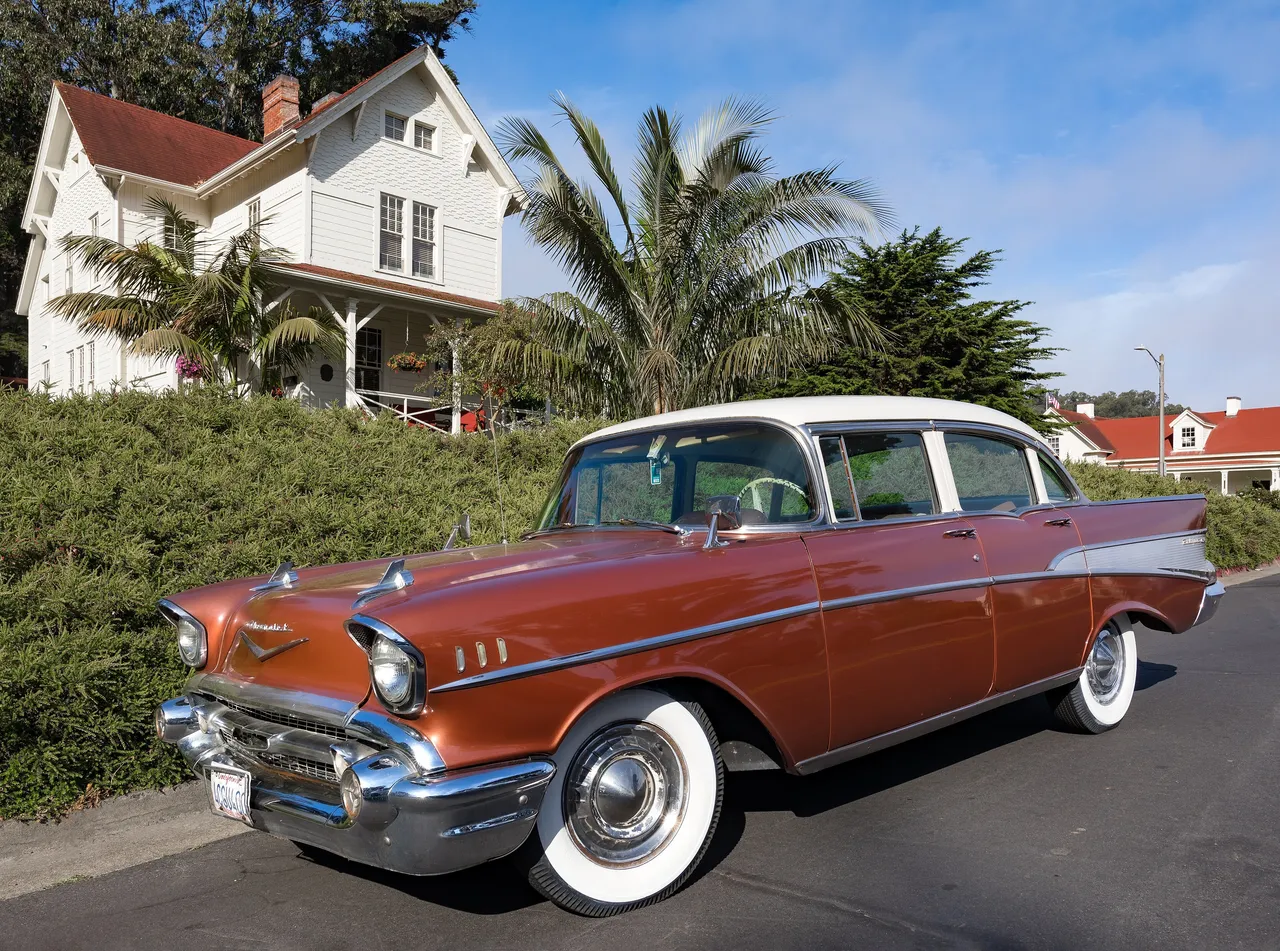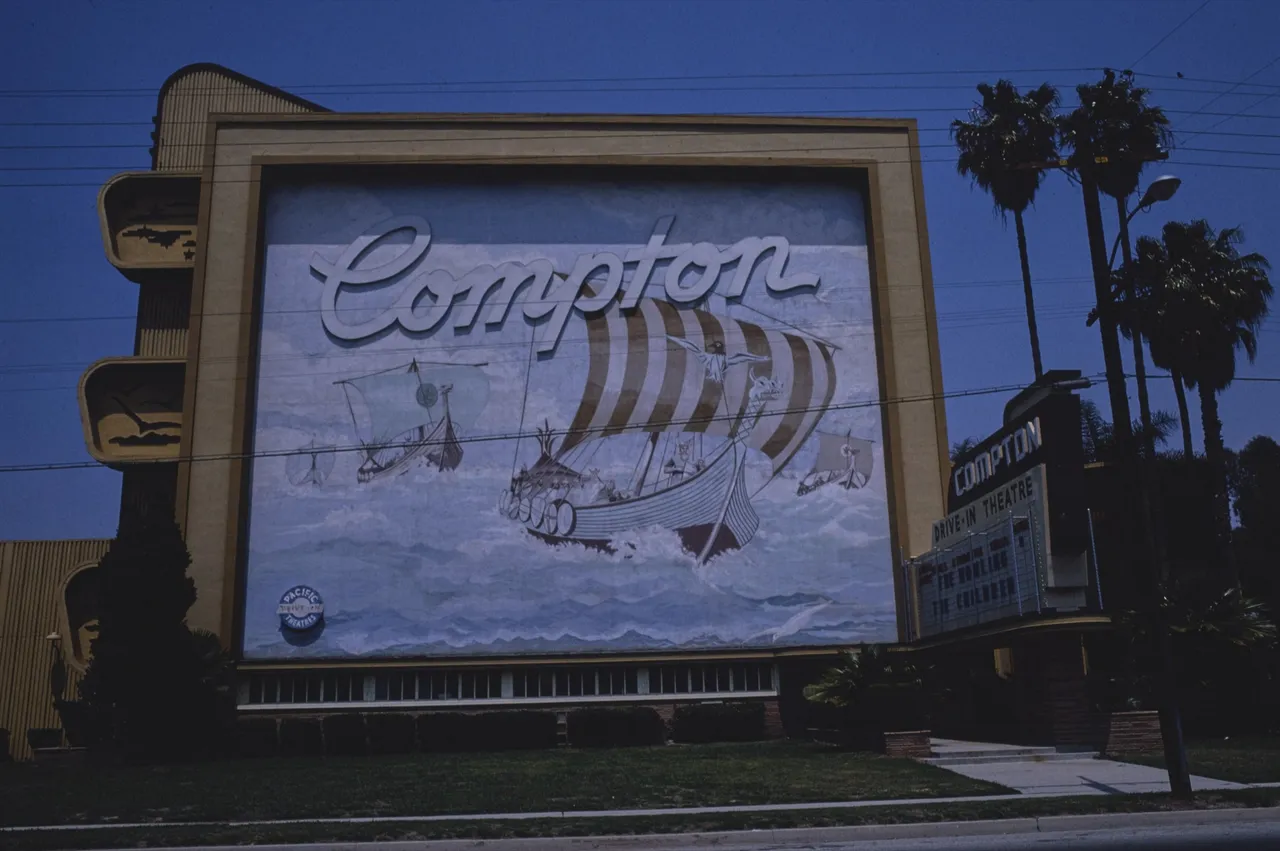
The first drive-in movie theater opened near Camden, N.J., on June 6, 1933, and the 1958 census counted 4,063 of them. Land grew more valuable as towns grew out, daylight saving time cut business in states that adopted it, and new theaters went indoors to shopping centers. About 280 were open in 2025. Shankweiler’s in Pennsylvania, which dates itself to 1934, is the oldest still running.
The first drive-in theater was tested in a downpour, to see what rain would do to the picture and the sound. The Motion Picture Herald wrote up the new lot outside Camden, N.J., in July 1933. “Windshield wipers offered some aid to vision,” it reported, and the sound was “declared to be little, if at all, impaired.”
You paid at a box office that put the Herald’s man in mind of “the ticket office of a ferry or toll bridge.” Then you switched off your headlights and drove onto one of seven rows of cinder ramps, oiled to keep the dust down and “to discourage mosquitoes.” The lot held 400 cars, on Admiral Wilson Boulevard in Pennsauken, though the trade papers just called it Camden.
The screen was 40 by 30 feet. Three RCA Victor loudspeakers sat two-thirds of the way up it, “for the purpose of creating the best illusion.” There were two shows a night, at 8:45 and 10:45.
It cost 25 cents for the car and 25 cents a person, but a carload never paid more than $1, about $26 in today’s money. The whole theater went up in three weeks, starting on May 16, 1933, the day the patent was issued.
Three stories about where the idea came from
“Why is it desirable to remain in your automobile when you go to the movies?” the Herald’s writer asked. “Only Mr. Average Man in his Chevrolet can answer that one.”
Richard M. Hollingshead Jr., the man behind it, was in the car-polish business, with a company that made the “Whiz” line. The Herald’s 1933 version starts at a gas station. Hollingshead had dreamed up a “Hawaiian Village” with thatched houses and pumps disguised as palm trees. To bring in customers in the evening, “when business tends to fall off,” he thought of showing movies.
Variety told it another way in 1949. The idea came to him in a long line at a New Jersey gas station: “Why can’t people have some form of entertainment while waiting to be served?” He tried it out in his Camden driveway, with cars parked 40 feet apart, blocks under their front wheels and a 16mm picture on a screen.
The United Drive-In Theatre Owners Association’s Jim Kopp gave Smithsonian a third one in 2008. In his telling, Hollingshead’s mother was “rather large for indoor theater seats.” “So he stuck her in a car and put a 1928 projector on the hood of the car, and tied two sheets to trees in his yard.”
The patent mentions neither the mother nor the palm trees. It describes stalls tilted up a little at the front, so the cars ahead “will not obstruct the view,” for audiences “particularly in rural sections.” Of the three stories, the Herald’s is the oldest, in print less than a month after the lot opened. The mother is the latest, told by a trade-group officer 75 years on.
The speaker on the post
The first drive-in had big speakers at the screen, and the neighbors complained. The Herald wrote in 1941 that people living near the Camden lot, and businesses too, had objected to the noise. Drive-ins answered with a speaker for every car, either placed inside it or buried in a manhole in the ground beside it.
The first in-car speakers were 8-inch units in sheet-metal cases, made to hang on the car door, and a metal post between each pair of cars held two of them. You set the volume to suit yourself, and you didn’t have to roll the windows down on a wet night. Some even had a jack for a hearing aid. At one drive-in, pranksters stuck a pin through a speaker on purpose. That shorted out a whole section of the field, and sometimes the entire lot, the 1945 Theatre Catalog reported.
The speakers soon started walking off. In Birmingham the management took down license numbers and mailed polite notes to the suspects. In April 1941 The Film Daily reported that “one boy brought back eight speakers he’d annexed from time to time, and had installed all over his home.” The Henry Ford museum has a set of EPRAD in-car speakers from about 1955 in its collections.
The Camden lot itself didn’t stay put. In the spring of 1941 it moved to Union, N.J., to a spot on Route 29, the main road to the Jersey beaches, and that October the Herald wrote that it had been “successful almost from the start.” A trade book a year later disagreed, calling it the one “failure” because it got pictures nine months after their last run, “and then only at prohibitive prices.” That book also put the move in 1937, four years earlier than the Herald did. We went with the Herald, which was reporting while it happened.
Pajamas, bottle warmers and a dog’s heart medicine
Children came in their pajamas, “ready to pop into bed.” Walter Brooks of the Motion Picture Herald saw them on a tour of northern New Jersey with Bill Smith, general manager of Eastern Drive-in Theatres, which ran four drive-ins in the state. He wrote it up for the paper’s Better Theatres section in October 1948. People took off their shoes and smoked cigars, and women came “without their girdles,” in house dresses and slippers.
One Morris Plains regular had a very old dog with a bad heart, and its medicine was kept ready in the manager’s office in case of an attack.
The Gratiot, near Detroit, billed itself as “America’s largest outdoor theatre,” with swings, slides, free pony rides, trained matrons to watch the children and free warming for the baby’s bottle. A button on the speaker called a roving vendor to your car.
The 1952 Theatre Catalog did the arithmetic in a photo caption that began “NINE-FOR-FREE.” The two adult tickets were “the only boxoffice return; but the nine little appetites will more than make themselves welcome at the refreshment stand.”
What the screen said to the cars
Between pictures, drive-ins ran short trailers from Filmack and National Screen Service. The same catalog printed sample copy with a blank for the theater’s name. “There is the cutest little fellow asleep in the car next to you,” one began. “Please don’t scare him half to death by blowing your horn.” Others told you to hang the speaker inside the window and not to flash your lights or ride the brake.
The National Screen Service copy said you could “COME as you ARE in aprons and slacks . . . even in your HOUSE SLIPPERS!” There was “NO BABY-SITTER PROBLEM,” and one trailer owned up to it: “Yes . . . we are unfair to baby-sitters.” Cool nights brought free coffee, and foggy ones brought “Fog Passes.”
Then came the intermission clock, which told you “exactly how many minutes” you had to get to the refreshment stand. By 1964 National Screen Service sold one made of short cartoons about a bowler, a golfer and a pool shooter, each ending on a minute reminder. Ads from local merchants ran in between.
Why most of them closed
In the North, Northeast and Midwest, a drive-in’s season ran only from the first day of summer vacation to the first day of school. In states that went on daylight saving time, those were daylight months, when dark came an hour later and the first show couldn’t start until it did. A 1961 survey of theater owners, reported in Boxoffice, found that drive-in business fell about 20% on average when a state first went on daylight time. After the first few years, the survey said, the loss eased.
So in North Carolina in 1965 the drive-ins led the fight against a daylight saving bill. They argued it would push their opening back an hour and run many of them out of business, and the bill died.
And the new theaters had already gone indoors, mostly into suburban shopping centers. The Commerce Department counted 278 theaters built or started in the two years before December 1962, Film Bulletin reported, and only 95 were drive-ins.
A short season made for a thin living, too. “There’s not enough income in it or else you’d see AMC or others getting drive-ins,” D. Vogel of the Bengies Drive-In in Maryland told Smithsonian in 2008. Vogel put the price of land first among the reasons, and told Smithsonian it was the real reason many drive-ins folded. “People would build on the outskirts of town,” he said, “and the town would grow.”
The Ypsi-Ann near Ypsilanti, Mich., went that way. Al Valusek, who ran its projector, remembered wasps nesting in the broken speakers. To him “it was obvious that that land was too valuable to be left alone as a drive-in.” The screen came down on Dec. 12, 1978, and the lot is a shopping center now.
From 1978 to 1988, by the owners’ association’s reckoning, more than 1,500 drive-in screens closed, a particularly hard stretch. In 1988 Ira Korff of National Amusements in Massachusetts said his chain had gone from 40 drive-ins to 20 in five years.
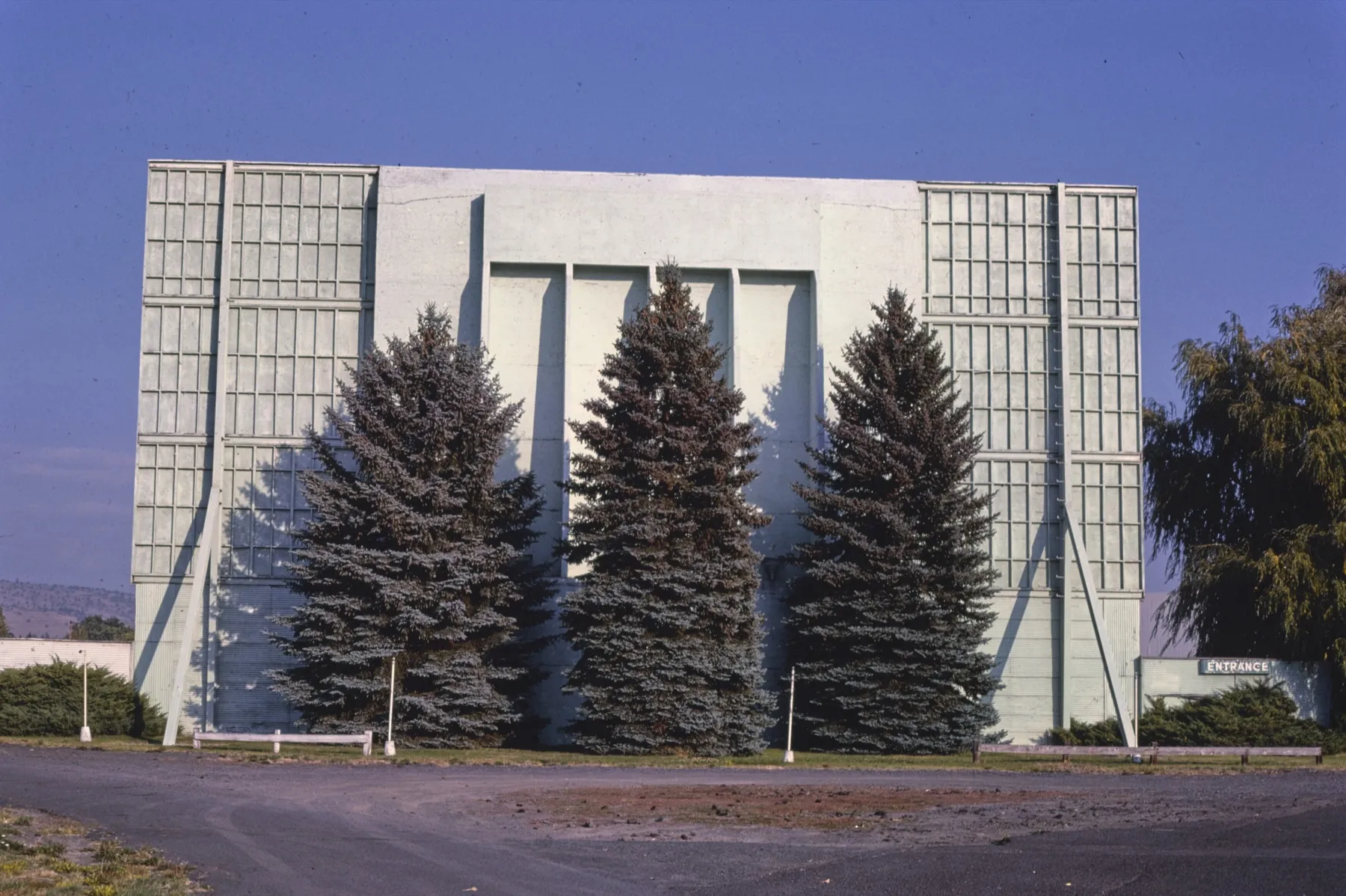
The Shasta Drive-in’s screen tower, Klamath Falls, Ore., 1987. Photo by John Margolies, Library of Congress, public domain, via Wikimedia Commons.
How many there were
| Year | Drive-ins | Who counted |
|---|---|---|
| 1933 | 1 | Motion Picture Herald |
| 1948 | 820 | Census of Business |
| 1958 | 4,063 | Census of Business |
| 1987 | 2,084 screens | National Association of Theater Owners |
| 2025 | 280 (480 screens) | United Drive-In Theatre Owners Association |
The census counted businesses, and the trade’s own estimates for 1958 ran higher, to about 4,800. History.com and drive-ins.com put the peak at about 5,000, but we found no document behind that number. The census counted 4,063 in 1958, and the trade papers we read put 1958 at about 4,800 and, in Film Daily’s yearbook, reached 6,000 only for 1961 and 1962. That 1987 figure counts screens, and one drive-in can have several.
The oldest one still running
Wilson Shankweiler ran a hotel in Orefield, Pa., north of Allentown. After a visit to the New Jersey drive-in, he turned a walk-in outdoor theater there into one. Shankweiler’s dates itself to 1934, and Guinness, which lists it as the oldest drive-in still in operation, gives April 15 of that year, while noting a 1937 newspaper notice of its grand opening.
Hurricane Diane wrecked everything but the entrance archway in 1955. Eleven years later a trade paper was calling it “the world’s oldest existing drive-in.”
Paul Geissinger, who later owned the place, told the National Trust that he said no when he was first asked to work in the projection booth, then agreed to two weekends while the owner looked for someone. Two weeks later nobody had turned up so he gave it three weeks, then another week, and stayed on. After he and his wife bought it the first years were “real rough,” he said, and on some nights the staff outnumbered the customers. Lauren McChesney is one of its owners now.
Drive-ins now, and where to find one
In May 2020, with the pandemic on, the Warwick Drive-In in New York sold out from its first night back. It could take only half its usual cars. For a few months that year drive-ins took most of the country’s box office. The owners’ association counted about 318 in 2021, up from about 305 in 2019, and the number has slipped since.
The United Drive-In Theatre Owners Association keeps that count state by state, though it warns that a theater’s season now and then gets logged wrong. In 2025 New York and Pennsylvania had the most drive-ins open, 26 apiece, then Ohio with 24 and Indiana with 19. New Jersey, where it started, had one. Delaware, Hawaii, Louisiana and North Dakota had none.
For many owners it’s “a second job,” John Vincent, the association’s president, said in 2025. Jim Kopp, who told Smithsonian the story of Hollingshead’s mother, bought a drive-in of his own in 2005, the Raleigh Road Outdoor Theatre in Henderson, N.C. By 2008 its sound came through car radios. Kids had been running through a hole in its fence. Kopp put out chairs and popcorn and a sign that said, “At least sit down and watch the movie.”
Questions people ask
Who invented the drive-in movie theater?
Richard M. Hollingshead Jr., a Camden, N.J., maker of auto polish. His patent for a “drive-in theater,” No. 1,909,537, was issued May 16, 1933, and his company, Park-In Theatres, licensed it to other drive-ins for 5% of their weekly gross. The patent didn’t last. A federal appeals court held that it “lacked invention,” and on Oct. 10, 1949, the Supreme Court declined to hear the appeal.
Why were drive-ins called passion pits?
A 1942 trade book recalled that even the first one, at Camden, was taunted as a “necker’s hangout” and “lover’s lane.” In 1951 an Indiana bill would have made drive-ins hire one policeman or matron for every 50 cars. A projectionists’ journal put the name down partly to the dim early screens, writing in 1956 that customers “didn’t take seriously” a picture they could barely see. In 1964 an editorial said drive-ins had taken “a long time” to shake the “passion pit” name.
Did drive-ins come back during the pandemic?
For a while, yes. In May 2020 the Warwick Drive-In in New York sold out from its first night back, with room for only half its usual cars. From late March to mid-August 2020 drive-ins took 85% of the U.S. box office, by Comscore’s count, against 2.9% in 2019. The owners’ association counted about 318 drive-ins in 2021 and about 283 in October 2024.
Written by Wance Payton, Oct. 21, 2026
39 sourcesWhere these facts come from
- Motion Picture Herald, "The Drive-In Theatre: A Motor Age Experiment," Better Theatres, July 1, 1933, pp. 15–17 and 42
- U.S. Patent 1,909,537, "Drive-in theater," Richard M. Hollingshead Jr., issued May 16, 1933
- The Film Daily, "Crazy Over Speakers," April 25, 1941
- Motion Picture Herald, "Drive-Ins Becoming Multi-Million Dollar Branch of U.S. Exhibition," Oct. 4, 1941, pp. 43–44
- The Theatre Catalog 1942, drive-in section
- The Theatre Catalog 1945, drive-in sound
- Walter Brooks, "A Showman Goes to a Drive-In," Better Theatres (Motion Picture Herald), Oct. 23, 1948, p. 26
- Boxoffice, "Private Approach Speeds Traffic at Detroit Drive-In," July 17, 1948
- Theatre Catalog 1948–49, "The Gratiot Drive-In"
- William Ornstein, "Growth of the Roofless Theatre; 750 Drive-ins Today Do Big B.O.," Variety, January 1949
- Motion Picture Daily, "High Court Again Denies Park-In Patent Appeal," Dec. 6, 1949
- The Exhibitor, Indianapolis column, Feb. 21, 1951
- 1952 Theatre Catalog, sample drive-in trailer copy
- 1952 Theatre Catalog, drive-in services ("Nine-for-free")
- International Projectionist, editorial, April 1956
- Motion Picture Exhibitor, "Drive-In, Once Industry Stepchild, Is Here To Stay, SEP Article Says," Sept. 19, 1956
- Motion Picture Herald, "1954 Receipts $1,415,763,000," May 26, 1956
- Motion Picture Exhibitor, "Tax Assessments," Sept. 21, 1960, p. 16
- Motion Picture Exhibitor, "Census Shows Less Theatres," Nov. 23, 1960, p. 15
- Boxoffice, "Daylight Saving Time in 17 States; Survey Shows Effect on Theatres," March 13, 1961
- Film Bulletin, Dec. 24, 1962, p. 24
- Motion Picture Exhibitor 1964 Theatre Catalog Edition, National Screen Service intermission clocks, April 1, 1964, p. 56
- Motion Picture Exhibitor, "The Public Needs a Watchdog," Oct. 14, 1964
- Motion Picture Exhibitor, "N.C. Daylight Saving Bill," March 31, 1965
- Motion Picture Exhibitor, Philadelphia column, Sept. 21, 1966, p. 17
- Elizabeth L. Levitan, "The drive-in is still thrivin'," Christian Science Monitor, Sept. 8, 1988
- Ross Atkin, "America's Oldest Operating Drive-In," Christian Science Monitor, Aug. 5, 1998
- Robin T. Reid, "The History of the Drive-In Movie Theater," Smithsonian, May 27, 2008
- Lauren Walser, "America's Oldest Drive-In Movie Theater Still Draws a Crowd," National Trust for Historic Preservation, June 27, 2013
- Kristen Gallerneaux, "Ford-Wyoming Drive-In: Scrapping at the Screen," The Henry Ford, Dec. 20, 2013
- Guinness World Records, "Oldest drive-in cinema"
- Shankweiler's Drive-In Theatre
- David Hampshire, "The Ypsi-Ann Drive-In Theatre," Ann Arbor Observer, May 25, 2023
- History.com Editors, "First drive-in movie theater opens," This Day in History, June 6
- Chris Coleman, "90 years ago today America's first drive-in theater opened in NJ," NJ101.5, June 6, 2023
- Reuters, "The drive-in movie stages a comeback in U.S. in coronavirus era," May 26, 2020 (via ARY News)
- Auzinea Bacon, CNN, "Drive-in movie theaters saw a surge in customers during the pandemic. Are they sticking around?," Aug. 23, 2025 (via KESQ)
- Berit Thorkelson, AARP, drive-in movie theaters, Sept. 3, 2025
- United Drive-In Theatre Owners Association, "Statistics," 2025 season