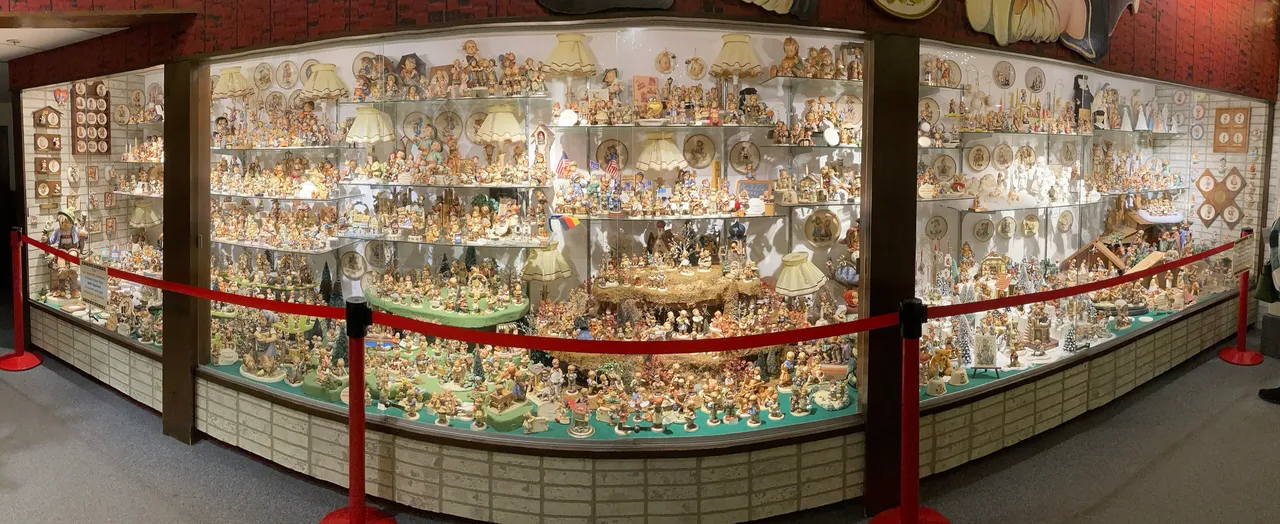
Most aren’t worth much. The biggest hits sold in the millions, and at an online sale of more than 1,200 albums run from Wilmington, N.C., in August 2024, 81 of the 89 lots sold by the album among the first 100 brought under $10 an album before fees. The exceptions are particular pressings, told apart by label, matrix number and mono or stereo, in clean condition.
At that Wilmington sale, one lot of 38 assorted albums went for $3, all of them together. That’s the winning bid, before a 16% buyer’s premium.
The auction house that ran it, Auction Orange, sold the collection online in 173 lots. Many were sold “times the bid,” which means the price was per album. One lot of eight, Jethro Tull among them, went for $1 each, $8 in all.
We counted the first 100 lots. Of those, 89 were sold by the album. In 81 of them the winning bid came to under $10 an album, and in 47 to under $5.
The top was $45 each, for four Beatles albums, and a single Magical Mystery Tour brought $22. Five Fleetwood Mac albums went at $9 each and five Elvis albums at $6 each.
A second count, on eBay two years later, pointed the same way. We took the U.S. sales of LP lots from Oct. 11 to 16, 2026, kept the ones whose titles said how many records they held, and left out best-offer deals. That gave 39 lots, at a median of $3 a record with shipping extra. The middle half ran from $2.07 to $7.40 a record, and 7 of the 39 came to more than $10.
In July 2022 one stereo copy of The Freewheelin’ Bob Dylan sold for $150,000 at Heritage Auctions in Dallas. It came from an early pressing that still had four songs replaced before the album came out in May 1963. What sets it apart from an ordinary copy is a short code etched into the vinyl near the label.
Why the biggest hits are among the cheapest
The record industry’s trade group, the RIAA, keeps a database of gold and platinum albums, and the familiar names are all over it. Meet the Beatles! went gold on Feb. 3, 1964, and is now at five times platinum. Tapestry is at 14 times platinum, Rumours at 21. Until 1975 an album went gold on a million dollars in sales. After that it took 500,000 copies, and platinum, a million, came in 1976.
Discogs, the big record database and marketplace, keeps a second scoreboard that matters more to a seller. Each release page shows how many members have that pressing in their collection and how many have it on their want list. We looked up the U.S. original pressings of five hits on Oct. 17, 2026, one Discogs entry each.
| Album | RIAA certification | Discogs members who have it | Who want it |
|---|---|---|---|
| Mitch Miller, Sing Along With Mitch (Columbia, 1958, stereo) | Gold | 355 | 6 |
| Johnny Mathis, Johnny’s Greatest Hits (Columbia, 1958, mono) | 3X Platinum | 3,925 | 67 |
| Herb Alpert’s Tijuana Brass, Whipped Cream & Other Delights (A&M, 1965, stereo) | Gold | 1,036 | 185 |
| The Beatles, Meet the Beatles! (Capitol, 1964, mono) | 5X Platinum | 1,682 | 403 |
| Carole King, Tapestry (Ode, 1971) | 14X Platinum | 3,666 | 789 |
A certification counts what was shipped, by the copy or, for albums from before 1972, by the dollar. Either way an album at three, five or 14 times platinum went out by the millions. The Discogs counts show what that leaves behind. Owners outnumber the people looking by about 59 to 1 for Sing Along With Mitch and Johnny’s Greatest Hits. With that many copies already in collections, a buyer can always find another one, and that keeps the price down.
The reverse shows up where the wanting has caught up with the owning, and those pressings stop being cheap. On the same day, Elvis Presley’s first RCA Victor album, LPM-1254 from 1956, had as many members wanting it as owning it, close to 3,000 each. The first-state Butcher cover of the Beatles’ Yesterday and Today had 445 owners and 3,011 people waiting, nearly seven for every owner.
What a record cost new
A 12-inch LP from Capitol or Decca listed at $3.98 in January 1955, and the suggested cost to a Decca dealer was $2.47. By June 1967 the labels had settled on one price for a standard album, mono or stereo. Most of the Wilmington lots brought under $10 an album, less than a quarter of what a new LP cost in either year once you allow for inflation.
| What | When | List price then | In today’s money |
|---|---|---|---|
| 45 rpm single, Capitol and Decca | January 1955 | $0.89 | $11 |
| 10-inch 78 rpm single, Capitol | January 1955 | $0.98 | $12 |
| 12-inch LP, Capitol and Decca | January 1955 | $3.98 | $50 |
| 12-inch LP, mono or stereo, the new standard | June 1967 | $4.79 | $48 |
List prices from Billboard, Jan. 15, 1955, and Billboard, June 17, 1967; today’s money from the government’s consumer price index.
How to tell which pressing you have
Start with the label. Most copies of “Wipe Out” came out on the Dot label, and those are worth $10 at most, the appraiser John “Mighty John” Marshall wrote in 2021. Copies on the DFS label go for up to $3,000. He gave four guide values for Meet the Beatles! in near-mint shape.
- a mono copy without producer and publishing credits below the liner notes: about $1,000
- a mono copy with those credits: about $400
- the 1969 Capitol Record Club issue, green label: about $125
- the 1978 purple-label reissue: about $10
Those are guide figures for near-perfect records, not sales. In September 2024 a copy listed as “Original Meet the Beatles Album, fully tested and verified to play with no skips” sold for $5 at an online auction in Forney, Texas. The listing never said which pressing it was.
The catalog number on the label helps too. Capitol’s mono Meet the Beatles! is T-2047 and the stereo one ST-2047, and Columbia’s Freewheelin’ is CL 1986 in mono and CS 8786 in stereo. Match it exactly when you look a record up. Discogs has at least six separate U.S. entries for the 1965 Whipped Cream & Other Delights alone, split by mono or stereo and by the plant that pressed it.
The number in the dead wax
Then look in the runout groove, the blank stretch of vinyl near the label. The matrix number is etched there. It was used during manufacturing to keep track of the parts that made the record. Often it’s just the catalog number with an A and B or a 1 and 2 added. On a 78 each side has its own, pressed into the shellac in the smooth area between the label and the grooves.
On the $150,000 Freewheelin’, Side One’s matrix number reads “XSM-58719-1A,” and stereo copies pressed after it end in “2A” instead. If yours ends in 2A, it’s one of the later ones. The songs pulled before release were “Rocks and Gravel,” “Let Me Die in My Footsteps,” “Gamblin’ Willie’s Dead Man’s Hand” and “Talkin’ John Birch Blues.”
There’s a mono version with those four songs too, on CL 1986. Heritage sold one in April 2025 and says it was pressed “only once and only in the hundreds,” in Los Angeles in early 1963. Both sides of that copy, sure enough, end in 1A as well. What it brought is shown only to people who sign in to Heritage’s site.
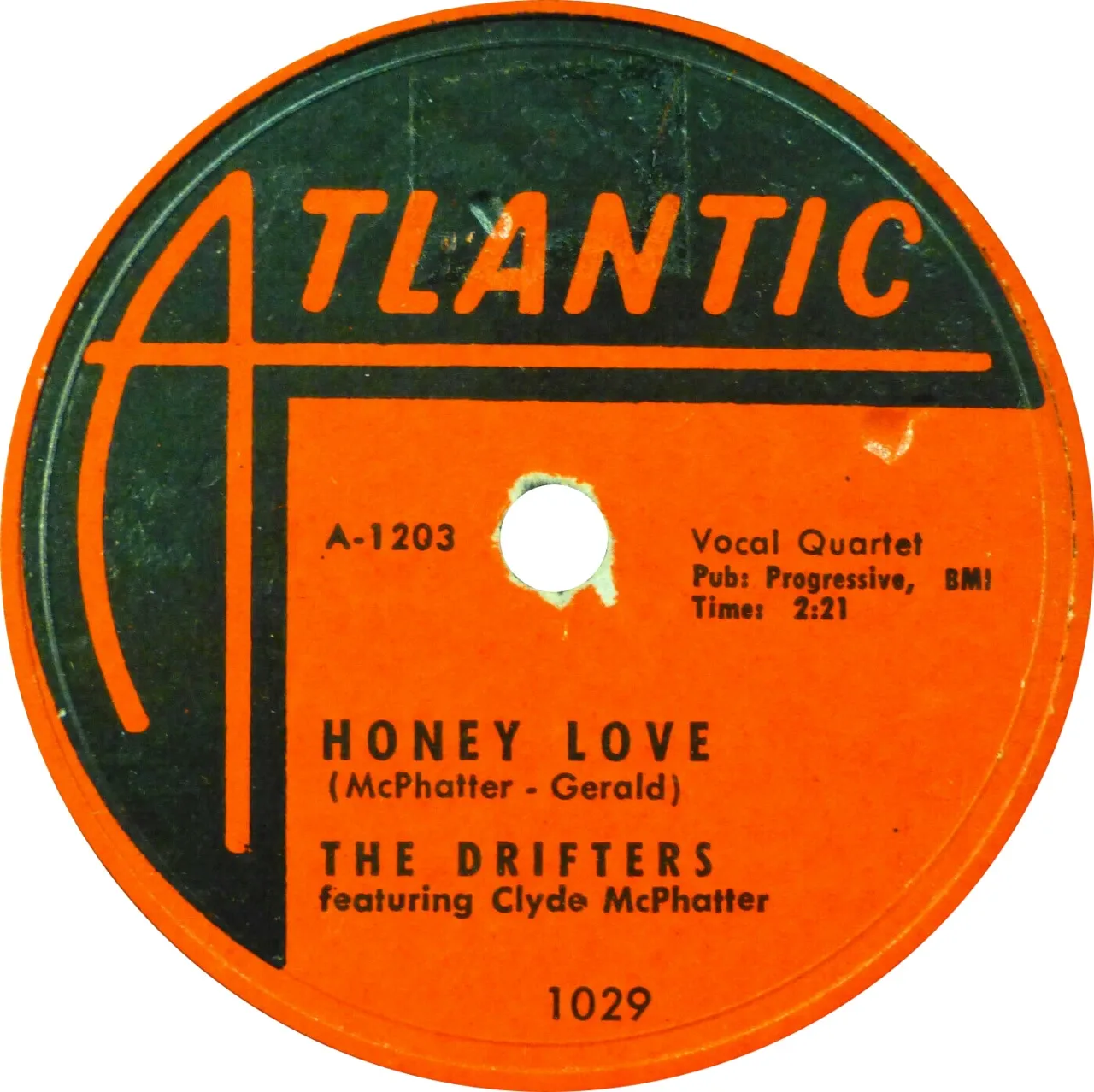
The label of an Atlantic 78 of “Honey Love” by the Drifters. Image via Wikimedia Commons, public domain.
The usual mark of a promotional copy is a white label in place of the regular color, or words such as “Demonstration — Not for Sale,” “Audition Record,” “For Radio-TV Use Only” or “Promotional Copy,” or both. Don’t count on a premium for one, though. In Goldmine’s words, “most promotional LPs sell for approximately the same as a stock copy of the same catalog number.”
A label that carries “BIEM,” “GEMA” or “MAPL” marks an import, which Goldmine’s U.S. price guide doesn’t list.
Mono or stereo: which is worth more?
Depends on the year. Mono outsold stereo every year from 1960 through 1966 in Billboard’s count of LP sales outside the racks. It was 76.5% of that count in 1960 and still 61.4% in 1966. Dealers quoted by Billboard in June 1967 said pop buyers were the ones holding on to it.
But in the pop market, where teen-agers are responsible for a major percentage of sales, monaural records either tie or slightly lead the figures.
The labels ended the cheaper mono LP anyway. On May 25, 1967, CBS said it would add $1 to the list price of every mono album on Columbia, Epic, Okeh and Date. RCA Victor followed the same day, and within a few weeks $4.79 was the base price for both. Capitol’s Stan Gortikov “deplored what he called the demise of the mono LP.” By 1968, says Neal Umphred, who wrote the Goldmine price guides from 1986 to 1996, most American companies had stopped making mono LPs.
By that reckoning the last mono pressings would be the scarce ones, and Marshall’s guide figures fit. For Speedway, Elvis Presley’s 1968 RCA soundtrack, he gave up to $100 for stereo and up to $4,000 for mono. At the start of the decade the same reasoning runs the other way. Stereo was under a quarter of the LPs counted in 1960, so an early stereo copy can be the scarce one. Marshall’s figures for Roy Orbison’s Crying album go that way, up to $400 in mono and up to $1,500 in stereo.
Condition decides the rest
“Nothing is more important in determining the value of your records than their condition!” That’s Goldmine magazine, in the grading guide it calls the most widely used one for buying and selling albums. A Near Mint record “looks like it just came from a retail store and it was opened for the first time,” and every grade below it sells for a share of that price.
| Grade | Share of the Near Mint price |
|---|---|
| Near Mint (NM) | full price |
| Very Good (VG) | no more than 25% |
| Good, Good Plus, Very Good Minus | 10% to 15%, “if you are lucky” |
| Fair, Poor | 0% to 5%, “if they go at all” |
Very Good Plus is the step in between, a record where “except for a couple minor things, this would be Near Mint,” and Goldmine puts no percentage on it. Very Good is the lowest grade most collectors will pay more than bargain-bin prices for.
Goldmine estimates that no more than 2% to 4% of the records left from the 1950s and 1960s are truly Near Mint. The writer of the guide adds, “I’ve found that most people with collections or accumulations have an inflated sense of the condition of their discs.” Grade under a strong light, and don’t give up on a scuffed one too fast, because LPs from the 1950s to about 1971 “tend to play better than they look.”
Where to look up a price
Discogs is the free place to start. Find the entry that matches your label, catalog number and matrix number, then look at the statistics box. The low, median and high there come from the last 30 sales of that release, says Discogs’ help page, and to see the sales one by one you need a free account and a captcha.
For rarer records there’s Popsike, an archive of more than 30 million auction results going back to 2004, limited to records that sold for about $20 or more. Free members get a limited number of searches a day, full membership runs about $21 for six months. Popsike itself warns that its prices “might not be a true indication of the record’s real value.”
What old 78s bring
A box of 78s the seller described as “probably at least 100 records in total,” all loose without sleeves, sold for $22.50 in St. Leonard, Md., in June 2017. That comes to 23 cents a record at most, in line with Old Phono, a phonograph dealer in northern California, which says the average value of most 78s offered to it is “$1 or less.” “Popularity generally means that millions of copies were made,” the shop explains, which is why it doesn’t get excited about Enrico Caruso or Bing Crosby’s “White Christmas.”
Most rare 78s, Old Phono says, fall into a handful of categories, among them jazz (not dance band) recorded before 1930, historically or politically interesting voices, and rock and R&B from 1947 to 1957. By its own count, Old Phono went through 500,000 records before it found a single copy of “Terrible Blues,” a 1924 Gennett by the Red Onion Jazz Babies with Louis Armstrong.
Before you sell the box
Before anybody puts a price on their box, go through these for each record that might bring more than a few dollars:
- the label: the company, its color, and whether it’s a record club issue or a later reissue
- the catalog number, where Capitol’s T and ST or Columbia’s CL and CS marked mono or stereo on the albums in this article
- the matrix number in the runout groove, on both sides
- a white promo label, or “BIEM,” “GEMA” or “MAPL” for an import
- the condition of the record and the cover, under a strong light
- what that exact pressing has sold for, on Discogs or Popsike
Marshall wrote in 2021 that “the vast majority of callers have records in the $25 price range.” Both of our counts come in well under that but his is a different kind of figure. It’s one appraiser’s impression of the calls he gets, and it deserves the same doubt as his guide values. He also wrote that a dealer “will generally pay no more than 30% of value.” By that rule a record worth $25 would bring about $7.50 from a dealer.
Going by where these sales happened, we’d send a box of mixed albums to a local auction house that sells online by the lot, as Auction Orange did in Wilmington. A pressing that passes every check on that list belongs with a house like Heritage in Dallas, where the $150,000 Freewheelin’ sold.
Questions people ask
Does a gold record certification mean my copy is worth more?
A certification measures how much an album sold, so a high one tells you the album is common. Before 1975 an album went gold on a million dollars in sales, and the mark is now 500,000 units, though albums released before 1972 can still qualify on dollars. Certification isn’t automatic. Someone has to apply for it, so an album without one may still have sold well.
Is a sealed album worth more?
A seal doesn’t settle it. Goldmine gives four reasons to be careful with sealed albums. They may have been resealed, the record inside may not be Near Mint, it may not be the original pressing, and it may be the wrong record altogether.
Is an album worth anything without its cover?
With some exceptions, Goldmine’s grading guide calls albums without covers worthless, and covers without the record worthless too.
Are old 45s worth anything?
A few are, and sometimes the paper sleeve is worth more than the record. In 2021 the appraiser John Marshall put a Beatles “Can’t Buy Me Love” 45 at up to $40 and its picture sleeve by itself at up to $800. As of October 2026, Elvis Presley’s 1954 Sun single “That’s All Right,” Sun 209, had 186 Discogs members wanting it and 21 who owned it.
Will a library appraise my old 78s?
The library at the University of California, Santa Barbara, says it cannot provide appraisals or advice on value. It suggests browsing eBay’s completed auctions by label or artist, which it calls a fairly reliable guide to the market for 78s, and notes that the Docks price guide covers mainly jazz, blues and hillbilly 78s, not classical or popular ones.
Written by Wance Payton, Oct. 25, 2026
25 sourcesWhere these facts come from
- Auction Orange, "Large Collection of Vinyl Albums Auction," Wilmington, N.C., lots sold Aug. 18, 2024 (HiBid catalog 568748)
- Auction Orange, lot 1, "Beatles Magical Mystery Tour Album" (buyer's premium and "times the bid" terms), HiBid
- Tanuki Stars, Forney, Texas, "Meet the Beatles vinyl Album," September 2024 (HiBid lot 214679705)
- Chesapeake MarketPlace, St. Leonard, Md., "Large Assortment of 78 RPM Records," June 22, 2017 (HiBid lot 32556053)
- RIAA, Gold & Platinum database
- RIAA, "About the Awards"
- Cash Box, "RIAA's New Album 'Gold Standard'," Feb. 1, 1975
- Billboard, "Price List Reflects Firmer Structure in Cost of Disks," Jan. 15, 1955, p. 33
- Billboard, "Col. to Raise Mono Price, RCA Too; Cue All-Stereo" and "Dealers & Racks: Will Hurt at First, Boon in Long Run," June 3, 1967
- Billboard, June 10, 1967, p. 3
- Billboard, June 17, 1967, p. 3
- Neal Umphred, "The Retail Price Of Singles And Albums 1948–1988," Rather Rare Records
- Goldmine Staff, "Record Grading 101: Understanding The Goldmine Grading Guide," Goldmine, June 22, 2010
- Discogs, "Database Glossary"
- Discogs Help, "Where Can I Access Sales History?"
- Discogs release pages (collection and want-list counts), read Oct. 17, 2026
- Angie Martoccio, "Masters of (Bidding) War: Rare Copy of 'The Freewheelin' Bob Dylan' Sells for $150,000," Rolling Stone, July 11, 2022
- Antiques and The Arts Weekly, "Bob Dylan Tops Charts At Heritage," July 12, 2022
- Heritage Auctions, lot 26312, Bob Dylan, The Freewheelin' Bob Dylan, mono, Columbia CL 1986, April 2025
- John "Mighty John" Marshall, "Is There Big Money in Your Vinyl Records?," Presbyterian Manors of Mid-America, Nov. 3, 2021
- Popsike, FAQ and About pages
- Old Phono, FAQ
- Yale University Library, "Cataloging 78 RPM recordings"
- UCSB Library, "What are my 78s or cylinders worth?"
- eBay, completed sales of LP record lots, Oct. 11–16, 2026 (read Oct. 17, 2026)