At U.S. auction houses, old Singer treadle and cabinet machines sold for $24 to $67.50 and Featherweight 221 portables for $150 to $480; on eBay in October 2026, Featherweights brought $182.50 to $650. To date yours, look up the serial number on the bed in the ISMACS tables. The date is when Singer assigned the number, so the machine was made about then.
In October 2024 a Singer in its cabinet, with the stool, the knee control and the foot pedal, sold at an online auction in Council Bluffs, Iowa, for $24. It worked. Its serial number, AF047094, belongs to a block Singer handed out on Aug. 16, 1938.
Of the 15 dated U.S. auction sales we found, five were treadle or cabinet machines and the other 10 were Featherweight 221 portables. D. A. Brumleve, a collector whose essay on values the collectors’ society ISMACS reprints, explains why most old machines bring so little: “Most 20th-Century machines were made in the millions, and most survive in great numbers.”
They got into all those homes on credit. Singer’s first machines, under Isaac Singer’s 1851 patent, were built for the manufacturing trades, and in 1856 the company’s Gazette proposed renting a machine to the housewife and counting the rent toward its price. Grace Rogers Cooper, in a history of the sewing machine the Smithsonian published in 1976, credits the idea to Singer’s partner, Edward Clark. Harvard Business School’s Baker Library says the credit plan tripled sales in a single year, and by the 1890s Singer agents were known for a hard-sell “dollar down, dollar a week.”
Where the serial number is, and what its letters mean
On a treadle or hand-crank machine, Singer says, look on the bed or the throat plate for a number of up to 8 digits. On older electrics it’s two letters and six numbers on the right-hand side. It’s often stamped on a small plate set into the bed, like this one:
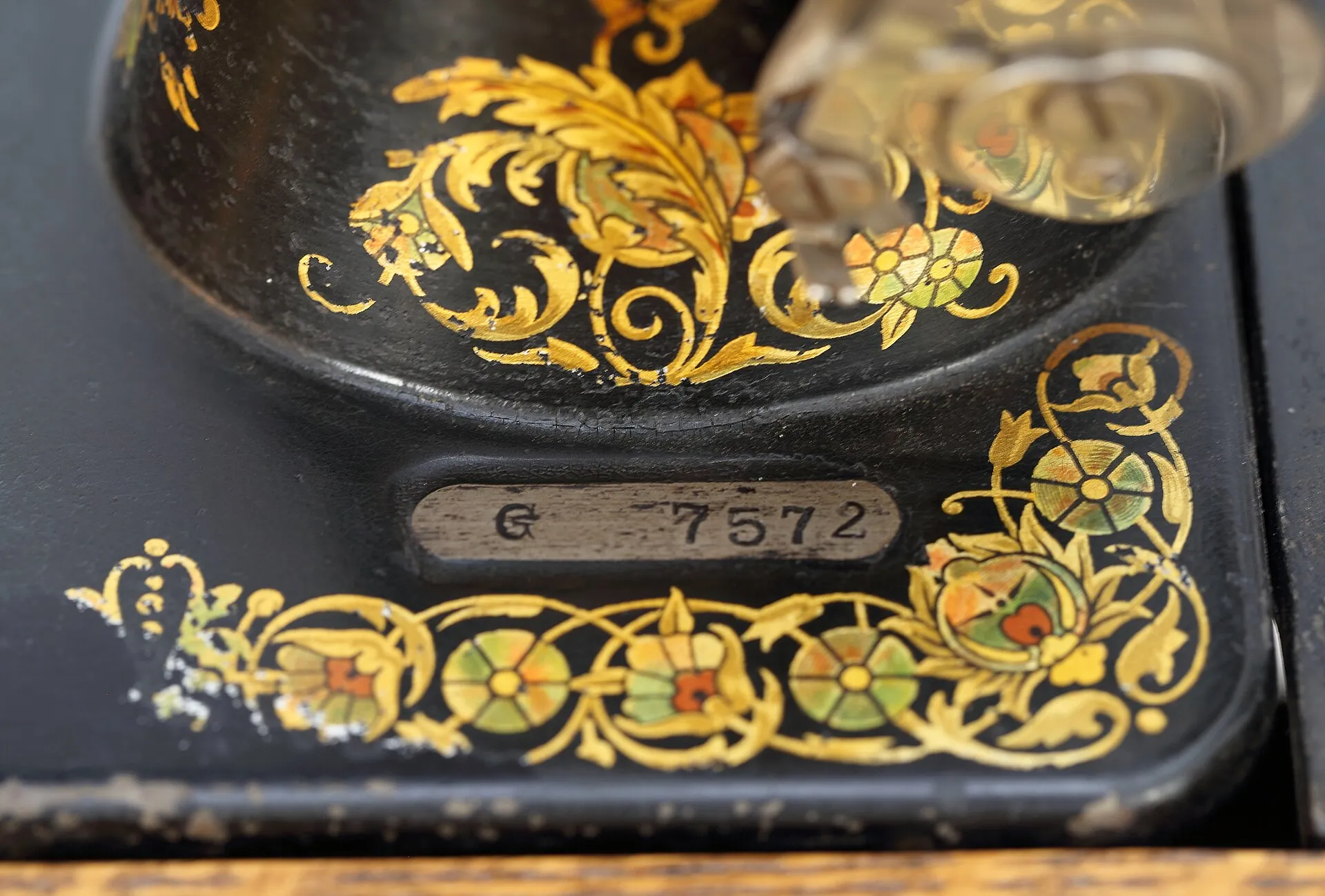
The serial number plate on a Singer Model 27. Photo by Cephas, CC BY-SA 4.0, via Wikimedia Commons.
The letters tell you roughly when, and which factory the machine came out of. ISMACS publishes charts drawn from Singer publications, and they break down like this:
| If the number starts with | Made at | Numbers handed out |
|---|---|---|
| Digits only | Singer’s U.S. and Scottish factories | before 1900 |
| One letter, such as N, K, H or G | mostly Elizabethport, N.J. | 1900 to 1924 |
| AA through AN | Elizabethport, N.J. | 1924 to 1959 |
| JA through JE | St. Johns, Quebec | 1924 to 1961 |
| NA, NB or NC | Anderson, S.C. | 1951 to 1961 |
| F, Y, or E plus a letter | Clydebank, Scotland | 1910 into the 1960s |
For the exact date, look up your number in the ISMACS serial number database. Each row there gives a block of numbers, the model it went to, how many machines and the day the block was allotted. ISMACS warns that those dates “are when the serial numbers were allotted and NOT the actual date of manufacture,” and gives the example of the Model 115, whose last numbers went out in 1935 while the last machine may well have been built in 1936. So your machine was made at that date or not long after, though at least one seller in our sample listed it as the “Date of Manufacture.”
A K in the model number is a different thing from a K in front of the serial number. A 15K or a 221K was made at Kilbowie, Singer’s plant in Scotland. Usually the same machine as the American one, too.
What old Singers sold for
Here are 10 of those sales, from auction houses that publish their results, with what each serial number says:
| Sold | Where | Machine | Serial number says | Price |
|---|---|---|---|---|
| Oct. 2024 | Council Bluffs, Iowa | Model 15 in cabinet, works | Aug. 16, 1938 | $24 |
| June 2026 | Monett, Mo. | Model 27 treadle, oak cabinet, gold Egyptian-style decals | July 30, 1900 | $57 |
| Feb. 2018 | Columbia, Mo. | Model 27 treadle, belt broken | July 24, 1907 | $65 |
| Feb. 2024 | Clearwater, Fla. | Featherweight 221, works | 1941 (seller’s date) | $150 |
| Mar. 2025 | Mt. Crawford, Va. | Featherweight 221, cord cracking | Aug. 22, 1950 | $195.20 |
| Feb. 2024 | Downingtown, Pa. | Featherweight 221, fitted case | not given | $300 |
| Feb. 2024 | Clearwater, Fla. | White Featherweight 221, works | 1964 (seller’s date) | $450 |
| Sept. 2024 | Mt. Crawford, Va. | Featherweight 221-1, case and manual | Feb. 20, 1952 | $461 |
| May 2026 | Las Cruces, N.M. | Featherweight 221, first batch, case repaired | Oct. 3, 1933 | $470 |
| Apr. 2024 | Loudon, Tenn. | Featherweight 221, works, accessories | Oct. 10, 1938 | $480 |
The prices are as each house reports them, so some include the buyer’s premium and some don’t. eBay, where many of these machines are sold, tells much the same story. Between Oct. 4 and 16, 2026, 11 Featherweights sold there at auction for $182.50 to $650, half of them for $250 or less, and the ones sold at a fixed price mostly brought $300 to $600.
The Featherweight, then and now
The Featherweight was a small electric portable, and the first 10,000 numbers for the 221 were allotted on Oct. 3, 1933, AD541546 to AD551545. Collectors say it made its debut at the Century of Progress fair in Chicago that year. Singer kept numbering them in Elizabethport until at least 1957 and in Scotland, as the 221K, until at least 1968.
ISMACS’s table of Singer’s average cash prices puts a new 221-1 at $88 from 1934 to 1941, at least $2,000 in today’s money. Collector sites give a higher figure, $125 to $150 in the 1930s to 1950s, without a dated ad or catalog behind it. Even the best Featherweight in our table, at $480, brought about a quarter of Singer’s price once inflation is counted, and most brought less.
The big console machines cost more. A Model 201 in a cabinet averaged $175 in cash from 1936 to 1946, over $3,000 now. On eBay in August and September 2026, Model 201 machines, most of them without a cabinet, sold for $300 to $400 when a seller had serviced them; one tested machine with its case brought $479.95, and two as-is machines went together for $190.
A dealer who services and guarantees Featherweights asks more than the auctions bring. AntiqBuyer says on its website, “I sell most Singer 221 Featherweights in the $595-$750 and up price range.”
What adds to the price, and what doesn’t
Singer’s list of what decides value is short: the model, the age, the condition, how rare it is and how much people want it. A working foot pedal, an intact case and all the original accessories can raise the value a good deal, the company says, and so can gold decals or custom engravings.
Decals alone didn’t help the 1900 treadle in our table, which had ornate gold Egyptian-style decals and four drawers and brought $57. Collectors have their own names for the decal sets. “Red Eye” is their slang for the set Singer called “Scroll (red),” while “Sphinx” really was a Singer name, and the ISMACS guide admits that some names were simply made up by enthusiastic collectors.
A cabinet can help in a shop more than at auction. On Antiques Roadshow in January 2024, the appraiser Karen Keane, looking at a Singer of about 1900 in an oak cabinet, said the machines themselves can be found for $100 or $150. For the cabinet, “if I were in a shop, I would add maybe another $300, $400 for it,” Keane said. At the Council Bluffs auction, machine, cabinet and stool together brought $24.
If you’re selling
Singer doesn’t give values itself, its value page sends you to completed sales on eBay, to Catawiki, to dealers and to ISMACS. It tells owners to go by completed sales instead of active listings. ISMACS warns on its pages that it can’t value a machine without having it in hand, and that requests for a valuation are ignored.
Brumleve has two rules of thumb for dealing with dealers. If one makes you an offer, “Multiply by at least 2.” And if you’re looking at a sticker in a shop, “Halve the dealer’s price for every three months it has sat unsold.”
Questions people ask
Will Singer tell me what my old machine is worth?
No. Singer’s value page points owners to completed sales on eBay, to Catawiki’s prices, to antique stores and dealers, and to the collectors’ society ISMACS. ISMACS says on its pages that a valuation isn’t possible without a hands-on assessment and that requests for one are ignored.
Why does my old Singer have two serial numbers?
Some early machines carry two numbers, one Singer’s and one Howe’s, the result of an 1854 agreement between Singer and Howe, according to ISMACS’s records of pre-1900 serial numbers.
When is a Singer an antique?
Singer itself calls a machine more than 100 years old an antique and one from 20 to 100 years old vintage. Treadle and hand-crank machines often fall in the first group.
Written by Wance Payton, Oct. 16, 2026
21 sourcesWhere these facts come from
- Singer, "Sewing Machine Value: What is Your Sewing Machine Worth?"
- ISMACS, Singer Sewing Machine Serial Number Database
- ISMACS, "Dating Singer Machines" (serial number chart by factory)
- ISMACS, "Singer Manufacturing Dates and Average Cash Cost"
- ISMACS, Pre-1900 Singer Serial Number Database
- D. A. Brumleve, "How much is my sewing machine worth?", via ISMACS
- John Langdon, "The ISMACS News Guide to Singer Ornamentation Sets," January 2012
- Needlebar Archive, Singer model numbers, via ISMACS
- Antiques Roadshow, "Appraisal: Singer Oak-cased Sewing Machine & Table, ca. 1900," PBS, aired Jan. 15, 2024
- Jeffrey S. Evans & Associates, lot 2055, Singer Model 221-1 Featherweight, Sept. 6, 2024
- Jeffrey S. Evans & Associates, lot 2044, Singer Model 221 Featherweight, Mar. 7, 2025
- Pook & Pook, Singer Model 221 Featherweight, Feb. 28, 2024
- HiBid, Singer cabinet machine, Oct. 27, 2024
- HiBid, Singer treadle with oak cabinet, June 2026
- NM Estate Auctions, 1933 Singer Featherweight 221, 2026
- AntiqBuyer, Singer Featherweights
- Baker Library, Harvard Business School, "Easy Payments: The Rise of Installment Selling"
- Grace Rogers Cooper, The Sewing Machine: Its Invention and Development, Smithsonian Institution Press, 1976
- Smithsonian National Museum of American History, "1851 - Isaac Singer's Sewing Machine Patent Model"
- eBay, completed sales of Singer Featherweight 221 machines, October 2026 (read Oct. 17, 2026)
- eBay, completed sales of Singer 201 machines, August–September 2026 (read Oct. 17, 2026)